Astrophotography diagnosis of NGC 4725: Tracking drift and sensor tilt
Raw180s07 avr. 2026
The Doc examined this image of NGC 4725 (raw, 180s). Estimated overall technical quality: 6/10. 2 defects found: Tracking drift (severity 3/5), Sensor tilt (severity 3/5).
&w=1920&q=75)
Info
- Cible
- NGC 4725
- Date
- 07 avr. 2026, 22:45
- Lune
- Croissant croissant 29.7% (sous l'horizon)
- Site
- Bortle 3 · rural peu pollué (VIIRS)
- Position
- 12h52m38s · +25°39'03"
Very favourable conditions. Bortle 3 and the Moon below the horizon (29.7% crescent, 86° from target): no lunar contribution is possible, and the sky background is indeed clean with no marked gradient on this sub. That is exactly the context a broadband galaxy like NGC 4725 needs, since its outer halo and faint arms require a dark background. The measured background to black point margin (e_margin 2.12) stays modest: under such a dark sky that is expected, and it mainly means you are not yet firmly sky-limited at 180s. Nothing in the conditions limits your session, everything comes down to mechanics.
Setup
- Type d'image
- Brut
- Télescope
- Epsilon
- Caméra
- Poseidon-M PRO
- Exposition
- 180s
- Phase de lune
- Gibbeuse décroissante (69 %)
- FOV
- 2.51°
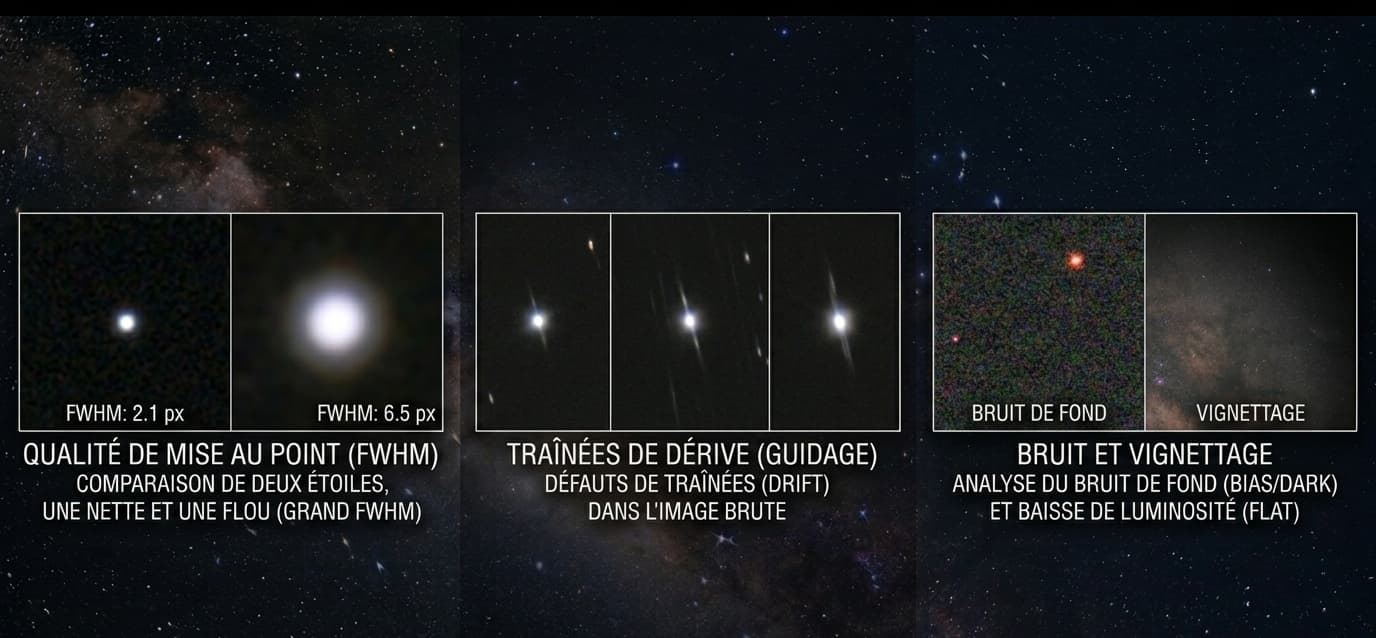
Setup well matched to the target. At 530 mm and 1.463"/px the sampling is comfortable for typical seeing, and NGC 4725 (about 10' across) fits easily in the 2.51° field, leaving room for NGC 4747 and the group companions. The central FWHM of 3.2 px, close to 4.7", is however higher than an Epsilon should deliver at this sampling: the tracking drift explains much of it. On settings, gain 125 and offset 50 are healthy (dark clipping at 0.01%, no truncated left tail), and a sensor at -15°C is fine. The 180s exposure is reasonable under Bortle 3, and you could even go longer once the tracking is sorted.
The diagnosis in detail
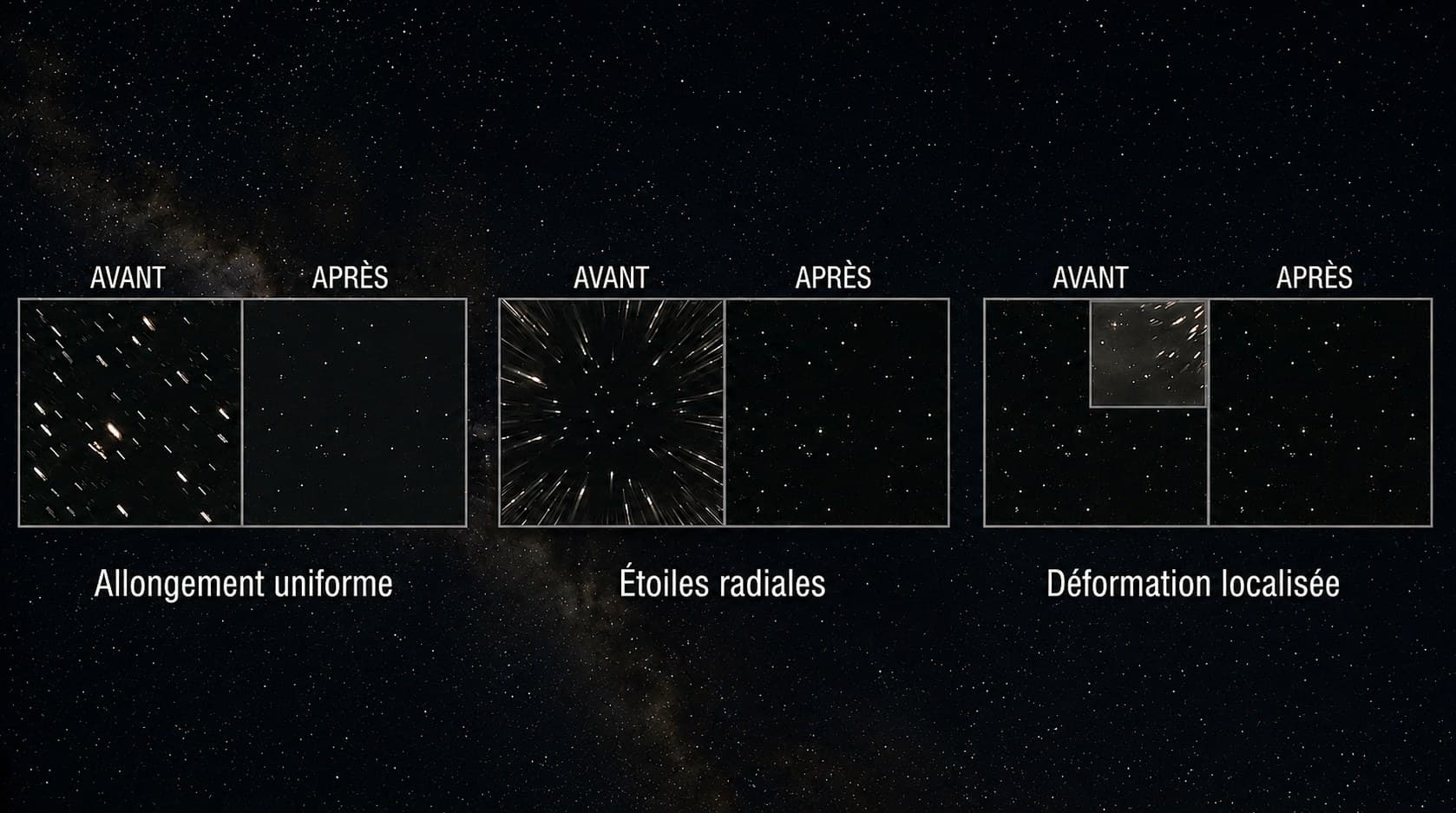
The diagnosis reads entirely in the Moffat metrics, and two distinct causes overlap. The first is mount mechanics: elongation reaches 1.39 at the field centre while the measured floor is 1.03, and the major axis direction is nearly identical everywhere (PA scatter of 7.3°, around -20°). An optical aberration always leaves the centre sharp; here the centre is the most elongated point of the field, which unambiguously points to drift during the 180 seconds.
The second is a tilted focal plane. Once the global elongation is set aside, a purely vertical size asymmetry remains: the top of the field sits around 3.2 to 3.4 px FWHM, the bottom around 4.0 to 4.25 px, with negligible horizontal asymmetry (0.044 against 0.239 vertically). This uni-axis gradient is the signature of a sensor not perpendicular to the optical axis, not a backfocus error, which would degrade all four corners symmetrically.
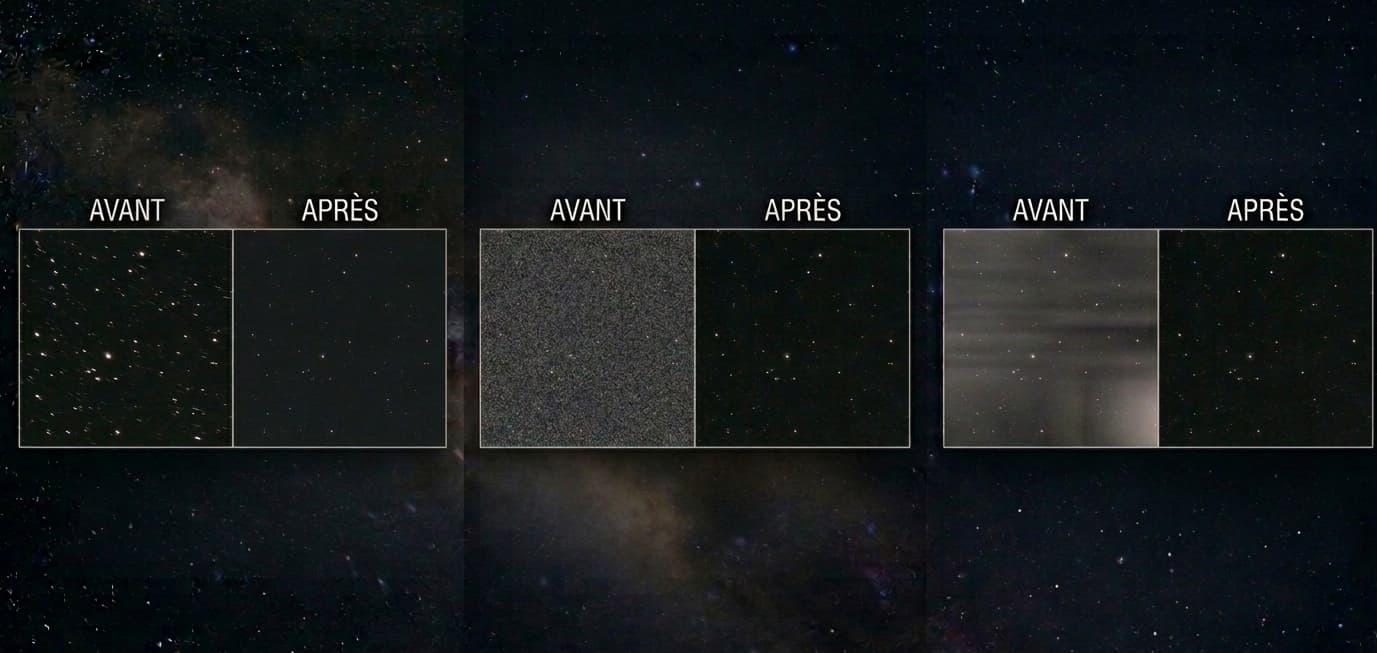
The rest is good: even background, no pattern artefacts, no stray trails, and the DSS comparison confirms that the faint tones around the galaxy are real signal rather than a gradient. Fix the tracking first, since it contaminates the tilt measurement, then take a fresh PSF panel to adjust the sensor plane on a clean basis.
Priority actions
- Redo polar alignment and recalibrate guiding, targeting total RMS below 0.7" before any new series
- Shoot a 60-90s test sub to see whether the central elongation disappears, which would definitively isolate the drift
- Measure then correct sensor tilt on the top/bottom axis with an adjustable tilt plate, after checking the Epsilon backfocus
- Take a control PSF panel once the tracking is clean, to quantify the residual tilt on a sound basis