Astrophotography diagnosis of ngc_6888_Cygni: Light pollution gradient
Raw300s05 sept. 2026
The Doc examined this image of ngc_6888_Cygni (raw, 300s). Estimated overall technical quality: 8/10. 1 defect found: Light pollution gradient (severity 2/5).
&w=1920&q=75)
Info
- Cible
- ngc_6888_Cygni
- Date
- 05 sept. 2026, 20:08
- Lune
- Gibbeuse croissante 67.3% (sous l'horizon)
- Site
- Bortle 2 · rural typique (VIIRS)
- Position
- 20h15m11s · +39°06'18"
Excellent conditions. Gibbous moon at 67% but below the horizon and 108° from the target, so no lunar contribution is possible, and a Bortle 2 sky puts the background at the natural sky level. This is exactly the context where a 300s Ha exposure on the Cygnus cirrus pays off: the faint IFN signal visible in the field, confirmed by the DSS, already shows on a single sub. Under such a dark sky you can lengthen exposures further or increase the sub count without fear of background saturation, the limiting factor becomes tracking stability rather than light pollution.
Setup
- Type d'image
- Brut
- Télescope
- EQMod Mount
- Caméra
- ZWO ASI585MM Pro
- Exposition
- 300s
- Phase de lune
- Dernier croissant (35 %)
- FOV
- 3.36°
Coherent setup but a very wide field for this target. At 190mm focal length and 3.15"/px you are clearly undersampled: the measured FWHM of 1.4 px confirms it, stars are barely one and a half pixels, so the optics and the sky are better than the sensor can resolve. NGC 6888 covers only a few percent of the 3.36° field. If the Crescent is the target, twice the focal length would suit better; if the goal is the Cygnus cirrus mosaic, this is ideal. Settings are healthy: gain 160, offset 15 with no dark clipping, sensor at -19°C. The background/black point margin e_margin=2.19 is low, but that is normal in narrowband at 300s, do not try to fix it.
The diagnosis in detail
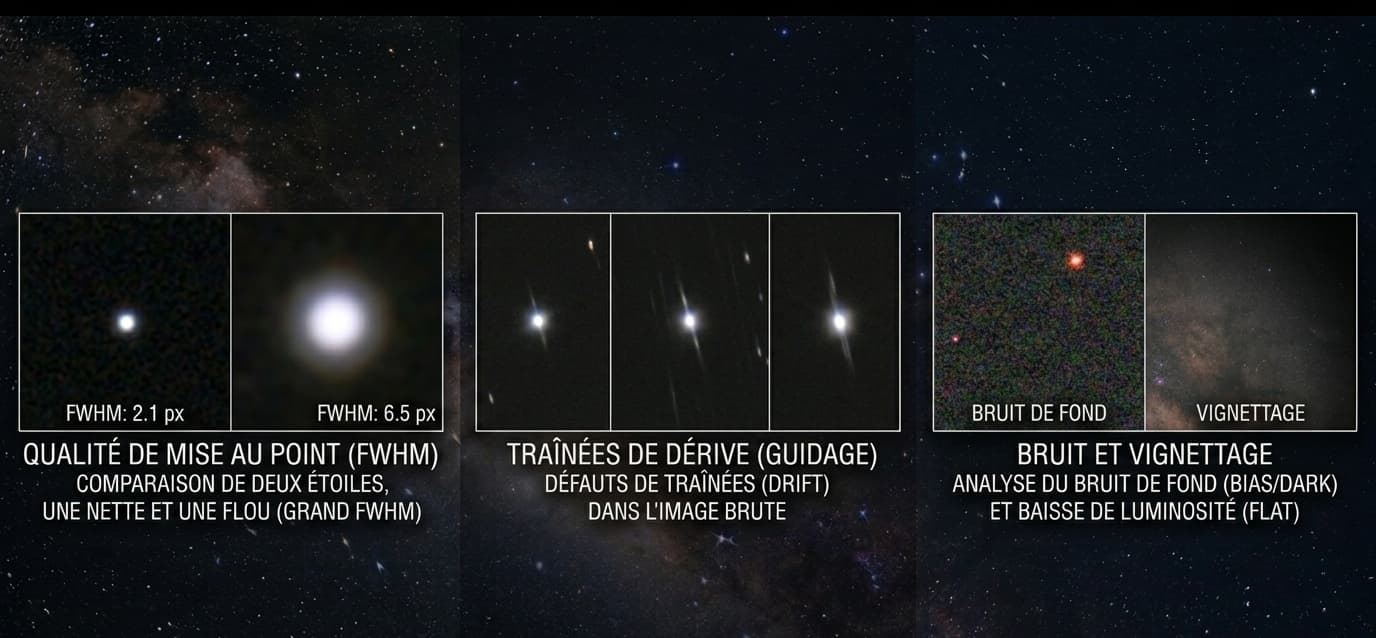
On star shape this sub is excellent. The nine PSF panel zones give FWHM between 1.36 and 1.61 px, with a corner/center ratio of only 1.113: no edge degradation, so no tilt, no backfocus error, no residual coma. Central elongation measured at 1.29 slightly exceeds the field floor (1.09), but with a PA dispersion of 36.6° across zones there is no coherent elongation direction: on 1.4 px stars this is Moffat fitting noise, not tracking drift. The indeterminate pre-verdict should therefore be resolved in favour of a clean PSF.
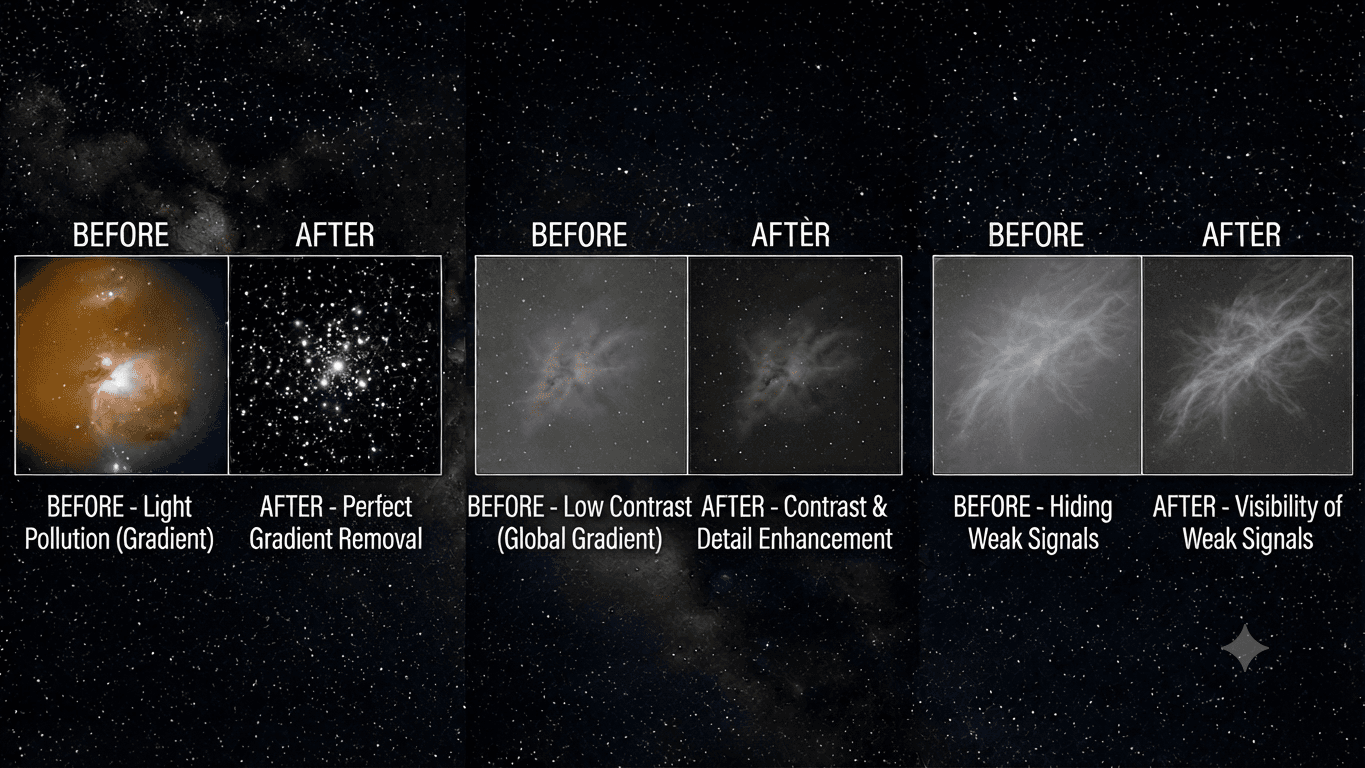
The only measured defect is the background. The radial model is worthless (R²=0.02) while the tilted plane explains 78% of the variance with near zero azimuthal anisotropy: this is an oriented gradient, not vignetting, and it removes trivially. Be careful not to confuse it with the real Ha nebulosity though: the DSS confirms the same filaments at the same positions across the whole field, including the dark central area. An overly aggressive background extraction would destroy that signal.
That leaves composition. NGC 6888 sits in the upper right corner, very small at this focal length. The field is mostly valuable for the surrounding Cygnus cirrus, but if the Crescent is indeed the named target, recentering is called for.
Priority actions
- Recenter NGC 6888 in the field, or commit to the wide field framing on the Cygnus cirrus
- Remove the tilted background plane (13%, oriented at 146°) after stacking, using a degree 1 model to preserve the Ha IFN confirmed by the DSS
- Keep stacking: the Bortle 2 sky and clean tracking justify accumulating a lot of integration on this field