Astrophotography diagnosis of NGC 6888: Tracking drift and sensor tilt
Raw300s20 juin 2026
The Doc examined this image of NGC 6888 (raw, 300s). Estimated overall technical quality: 6/10. 2 defects found: Tracking drift (severity 3/5), Sensor tilt (severity 2/5).
&w=1920&q=75)
Info
- Cible
- NGC 6888
- Date
- 20 juin 2026, 21:51
- Lune
- Gibbeuse décroissante 60.7% (14.1° d'alt., 122° de la cible)
- Site
- Bortle 2 · rural typique (VIIRS)
- Position
- 20h13m14s · +38°32'36"
Excellent conditions for this target. Bortle 2 guarantees a very dark background and favorable SNR, ideal in Hα on an emission nebula like the Crescent. The Moon (60.7% gibbous) sits 122° from the target and low on the horizon (14.1°): its impact is negligible, especially since a narrow Hα filter rejects most of its light. The measured background is flat (plane gradient only 6%), confirmed by the DSS showing real Cygnus cirrus, not light pollution. No reason to postpone the session: use this sky to gather more exposure.
Setup
- Type d'image
- Brut
- Télescope
- EQMod Mount
- Caméra
- ZWO ASI585MM Pro
- Exposition
- 300s
- Phase de lune
- Premier croissant (33 %)
- FOV
- 1.70°
Setup consistent with the target. At 375mm focal length, the 1.70° field places NGC 6888 (~20') comfortably at center with room for the OIII extensions, a good framing choice. The 1.595"/px sampling is ideal under current seeing, neither over- nor under-sampled, and the ASI585MM at -13°C handles thermal noise well. On settings, gain 220 is high: watch bright-star saturation but it stays usable. The background-to-black-point margin (e_margin 1.75) is low, which is NORMAL in narrow Hα at 300s, not a sign of underexposure. Offset 15 causes no dark clipping.
The diagnosis in detail
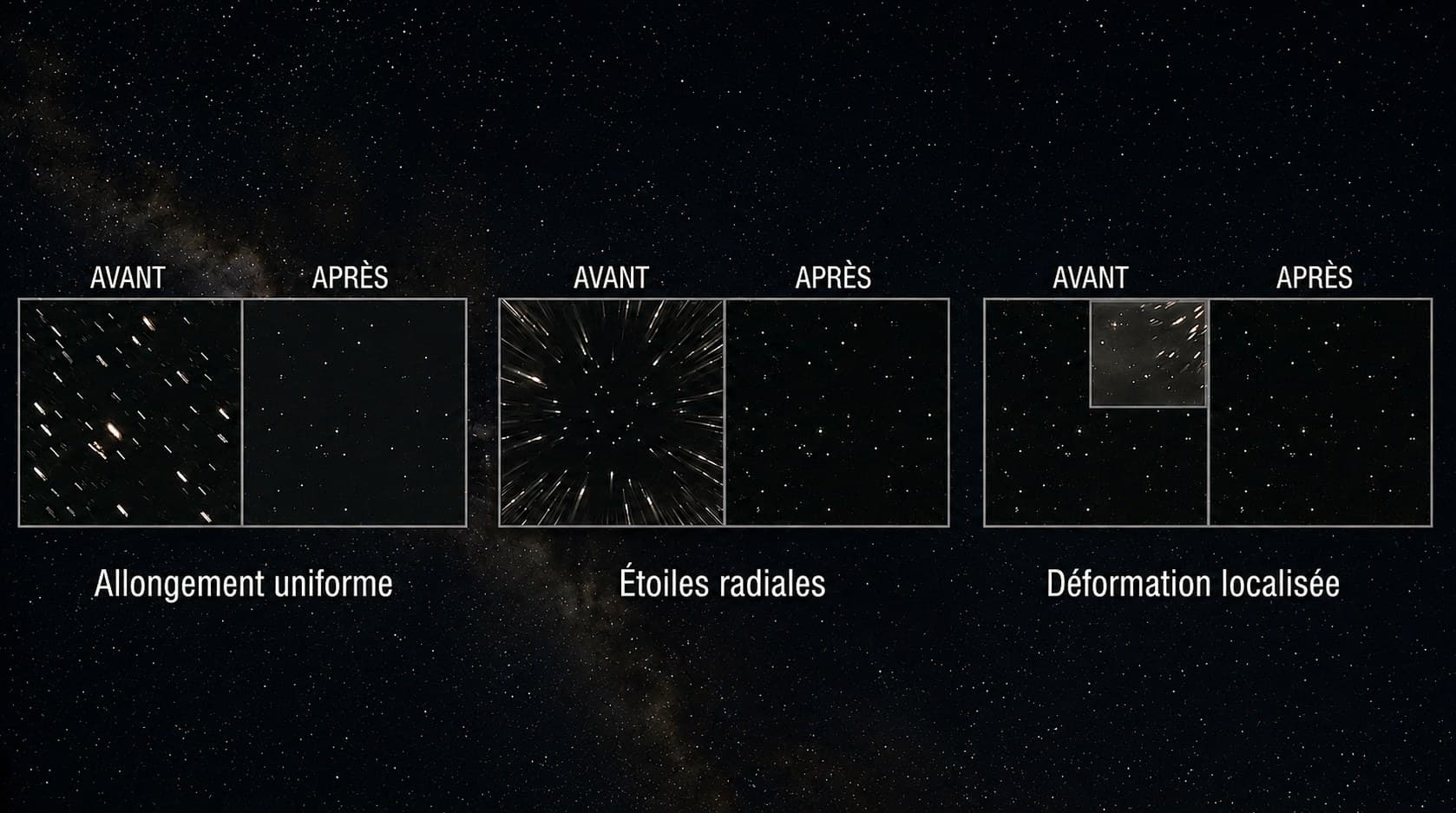
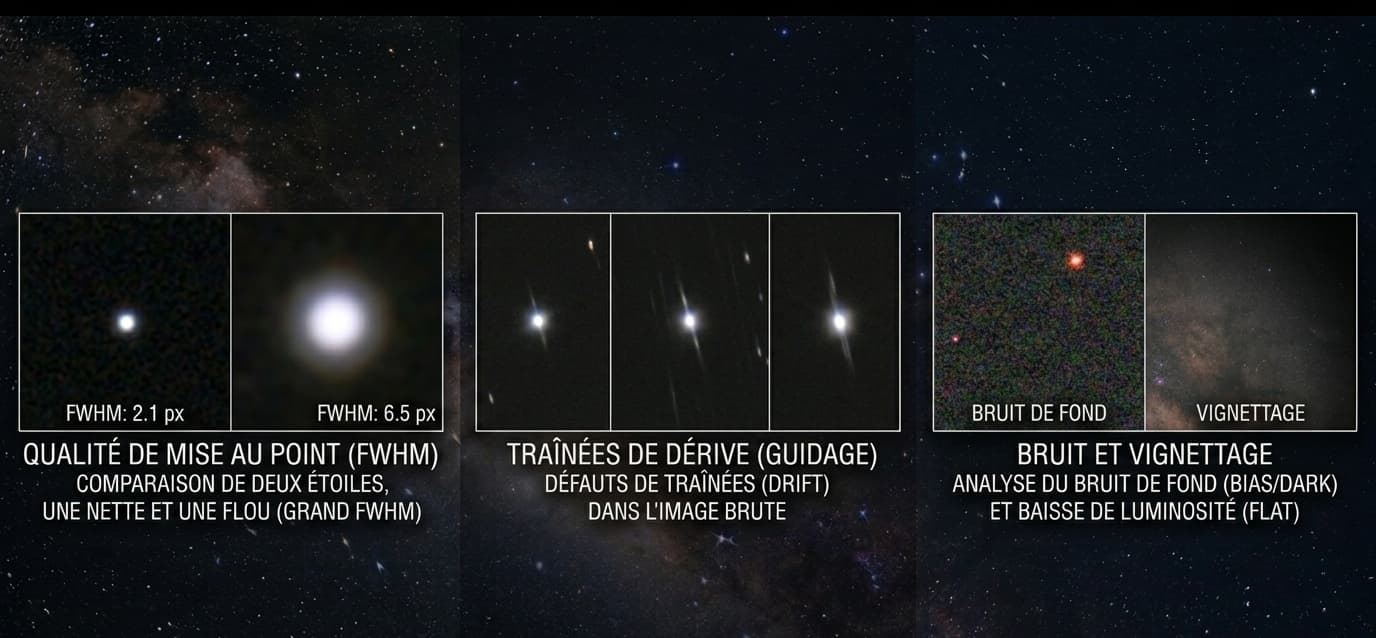
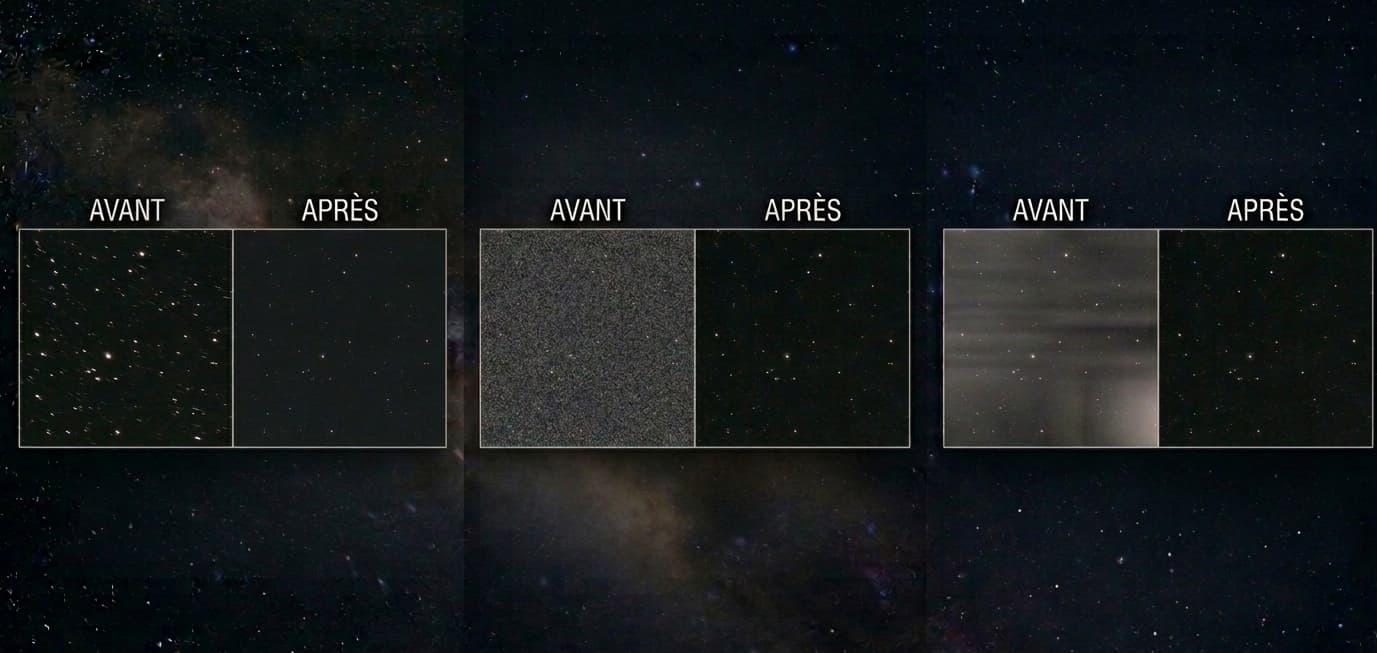
The image is a good Hα sub: the nebula is sharp and structured, the background benefits from a Bortle 2 sky, and the PSF plate shows a decent field core (FWHM ~2.4px at center, i.e. ~3.8"). The two limitations are on star shape. The first, dominant, is tracking drift: elongation reaches the center (elong 1.4 vs a field floor of 1.3) and keeps a very consistent direction (PA dispersion of only 13.9°, axis ~-41°). A purely optical aberration would leave the center round; here the center is stretched, so the mount is speaking, to be made reliable with better guiding and careful polar alignment.
Overlaid is a more subtle sensor tilt: the left edge and corner are clearly more degraded (L 1.8, BL 2.1, FWHM up to 3.65px) than the tight right side (R/BR ~1.30), with a horizontal FWHM asymmetry of 0.111. This is a focal-plane tilt, independent of tracking, fixable with a tilt plate. Once tracking is mastered and tilt adjusted, this setup has everything to produce excellent stars on this target.
Priority actions
- Make tracking reliable: autoguiding and careful polar alignment to remove the drift visible all the way to the center
- Adjust the sensor tilt (tilt plate) to equalize FWHM between the degraded left side and the right side
- Re-run a control aberration plate after adjustments to validate star roundness
- Accumulate exposure: the Bortle 2 sky and cooling allow deep Hα integration