Astrophotography diagnosis of NGC 6888: Light pollution gradient, tracking drift and 1 other
MasterH300s17 sept. 2025
The Doc examined this image of NGC 6888 (master, H, 300s). Estimated overall technical quality: 6/10. 3 defects found: Light pollution gradient (severity 3/5), Tracking drift (severity 2/5), Walking noise (severity 2/5).
&w=1920&q=75)
Info
- Cible
- NGC 6888
- Date
- 17 sept. 2025, 19:35
- Lune
- Gibbeuse croissante 83.9% (sous l'horizon)
- Site
- Bortle 2 · rural typique (VIIRS)
- Position
- 20h12m08s · +38°21'46"
Excellent conditions for this target: Bortle 2 and Moon below the horizon (so no lunar pollution despite its 84% phase, 120° separation). On an emission nebula shot in Halpha, this dark sky ensures high SNR and a clean background. The measured gradient is therefore not lunar in origin: it is an atmospheric/skyglow residual or low haze, easily corrected in processing. Nothing in the conditions limits the result here.
Setup
- Type d'image
- Master
- Télescope
- SkyWatcher 150 PDS Quattro
- Caméra
- ZWO ASI585MM Pro
- Filtre
- H
- Exposition
- 300s
- FOV
- 1.22°
Setup well matched to NGC 6888. The Quattro 150 PDS (600mm) paired with the ASI585MM gives about a 1.22° field, which comfortably contains the Crescent with room for surrounding nebulosity without losing it. Sampling is fine (2.9µm pixels at 600mm, ~1 arcsec/px), comfortable under typical seeing; the measured ~6.8 px center FWHM mostly reflects guiding and seeing, not the optics. The Halpha filter is a good choice on this emission nebula. The 300s narrowband exposure explains the low background margin (e_margin 1.5), which is normal here and should not be mistaken for underexposure.
The diagnosis in detail
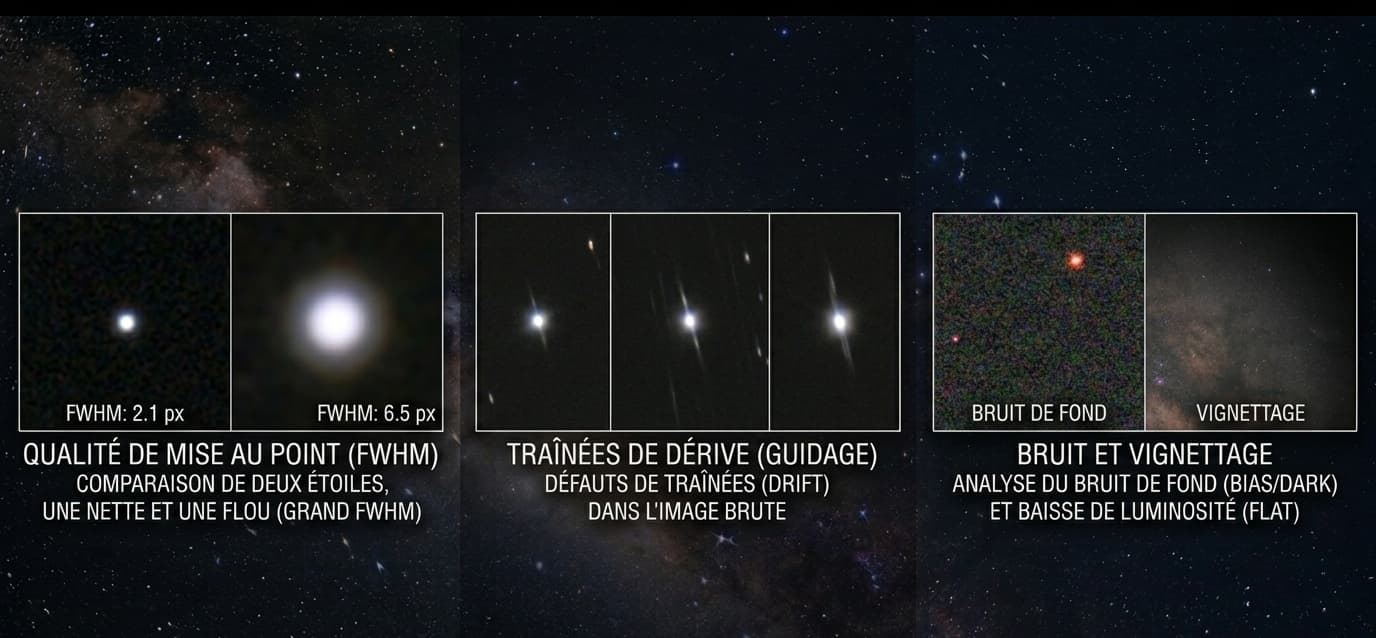
On star shape, the PSF panel shows generally healthy stars: the center is slightly elliptical (elong 1.17) and crucially this elongation persists with a nearly constant direction across all nine zones (PA spread 4.7°). A deformation reaching the center with a uniform direction is not a field optics issue but a tracking signature: slow uncorrected drift or imperfect guiding. The 1.10 corner/center ratio and negligible FWHM asymmetry confirm there is no tilt, backfocus or coma to report.
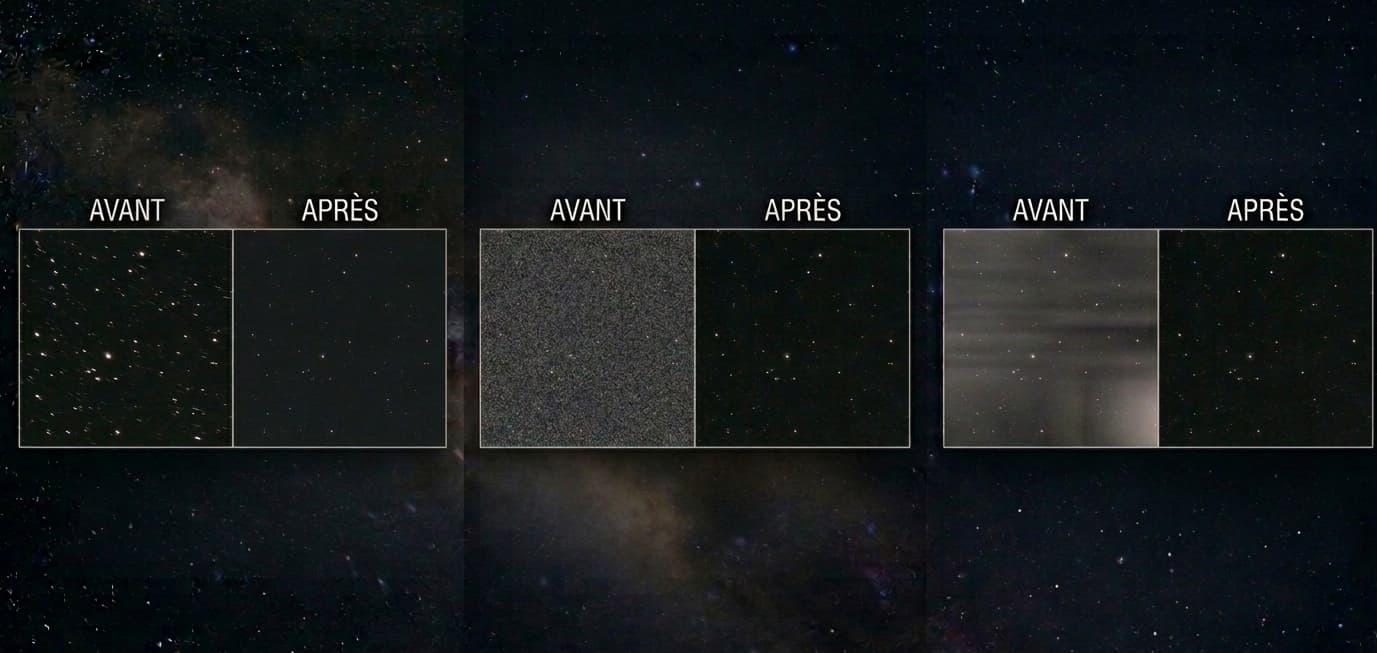
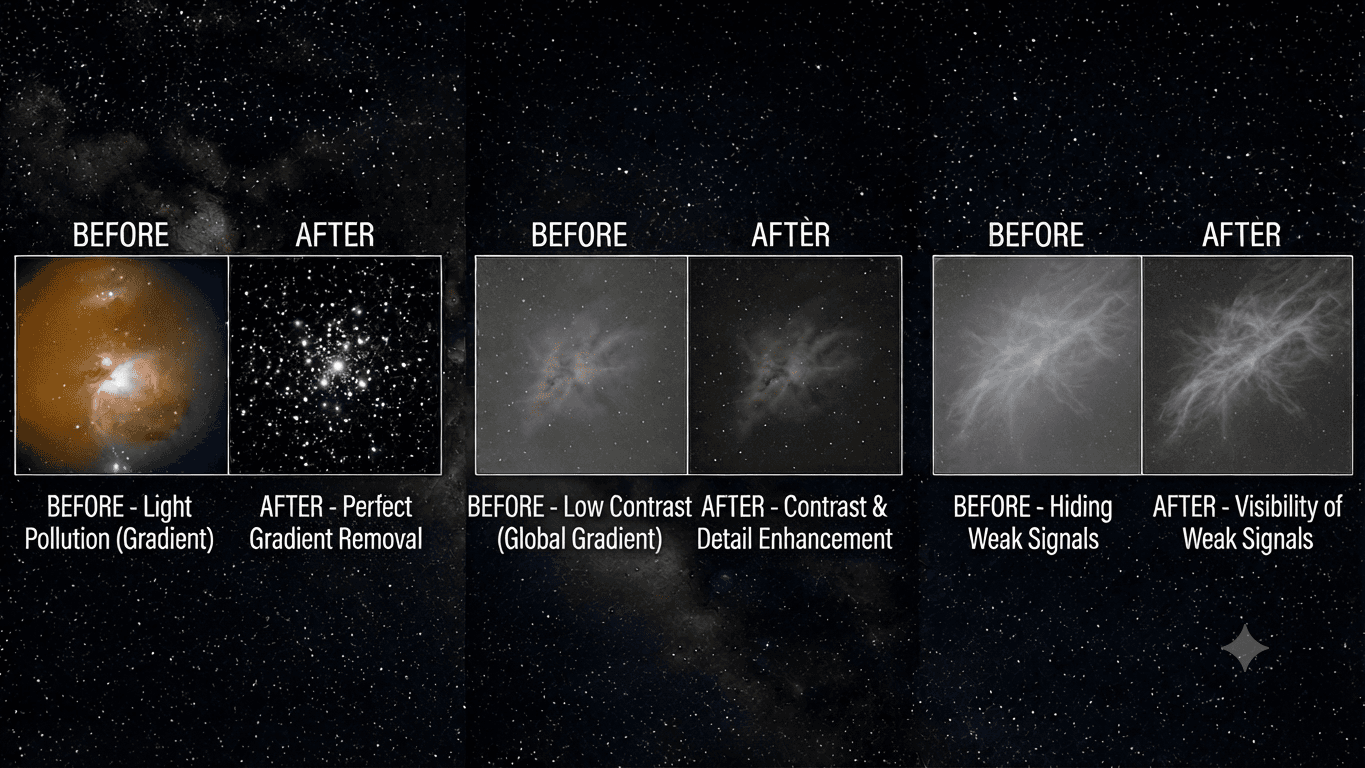
The dominant issue is the sky background. The illumination map reveals a plane gradient of 71% amplitude, oriented at 55°, dominating the radial component by a factor of 4.3 (R²=0.78). Under Bortle 2 with the Moon set, this is not a lunar gradient; it is an atmospheric/skyglow residual or low haze, fully recoverable with gradient extraction. A fine oblique pattern at ~158° additionally suggests a walking-noise remnant, typical when dithering is insufficient and the tracking drift propagates it.
Overall this is a promising master: clean optics, well-framed target, solid Halpha signal. The priority is to improve tracking/guiding and tighten dithering at acquisition, then extract the gradient in processing.
Priority actions
- Extract the background gradient (DBE/ABE or GraXpert) on the master before any stretch
- Refine polar alignment and tighten autoguiding to reduce drift (center elong 1.17)
- Enable generous dithering between subs to eliminate the walking-noise residual