Astrophotography diagnosis of NGC 6960: Tracking drift and light pollution gradient
Raw300s07 sept. 2026
The Doc examined this image of NGC 6960 (raw, 300s). Estimated overall technical quality: 7/10. 2 defects found: Tracking drift (severity 2/5), Light pollution gradient (severity 2/5).
&w=1920&q=75)
Info
- Cible
- NGC 6960
- Date
- 07 sept. 2026, 22:05
- Lune
- Gibbeuse croissante 87.3% (sous l'horizon)
- Site
- Bortle 2 · rural typique (VIIRS)
- Position
- 20h49m48s · +30°25'46"
Very favourable conditions. The declared Bortle 2 is the best possible case for a fine-filament target like the Veil, and the Moon is below the horizon at 128 degrees separation, so no lunar contribution is expected despite the gibbous phase. It shows in the image: the background is very dark and the faintest filaments of the western loop already appear in the single sub. The slight tilted plane measured on the background is therefore not heavy urban pollution but rather an airmass or local stray light effect, easy to correct. In this context the room for improvement is on the tracking hardware, not the sky.
Setup
- Type d'image
- Brut
- Télescope
- EQMod Mount
- Caméra
- ZWO ASI585MM Pro
- Exposition
- 300s
- Phase de lune
- Dernier croissant (16 %)
- FOV
- 3.36°
The setup matches the target well. At 190mm focal length the 3.36 degree field comfortably contains NGC 6960 and extends toward Pickering, which is the right framing for this region. However, 3.15 arcsec/px is clearly undersampled for a 2.9 micron sensor: stars are only 1.4 to 2 px FWHM, which limits detail and makes the PSF fit noise-sensitive. That is acceptable for wide field, but any tracking error shows up fast. On settings, gain 130 and -15.5C are sound, and offset 15 produces no dark clipping. The background to black point margin of 2.02 is low, which is normal and expected on a narrowband sub or under a very dark sky: do not lengthen the exposure because of it.
The diagnosis in detail
This is a 300s sub on the Veil Nebula, and its intrinsic quality is good. Comparison with the DSS reference confirms that every filamentary structure visible, the NGC 6960 loop on the left and the Pickering strands on the right, is real signal and not artefact: they overlay position by position.
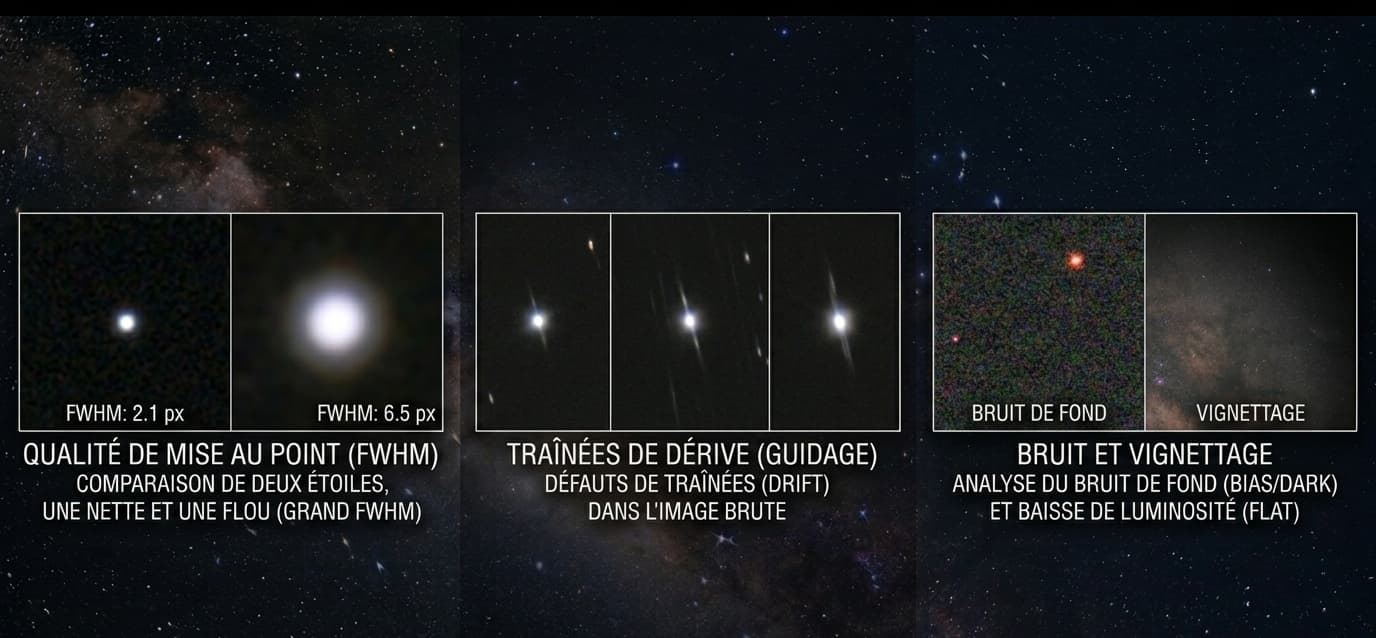
The only measured shape defect is a moderate elongation that reaches the field centre. That is the key discriminant: an optical cause (tilt, backfocus, coma) leaves the centre sharp and degrades the edges, whereas here the centre is the most elongated zone (1.41) and the corner/centre ratio is 0.892, so corners are actually better. With a PA spread of only 4.8 degrees, the elongation direction is the same everywhere, the classic signature of a tracking drift. The 27% tilt candidate is not retained, as the PSF sheet shows no diagonal asymmetry between opposite corners.
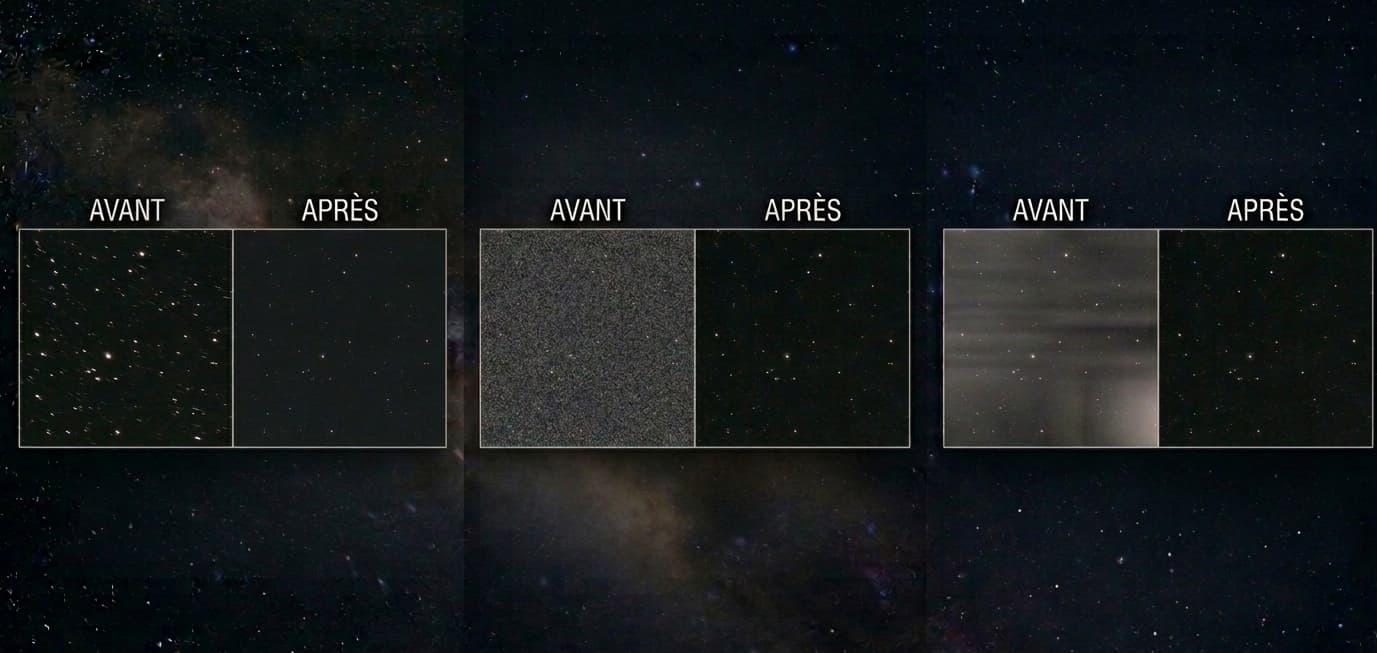
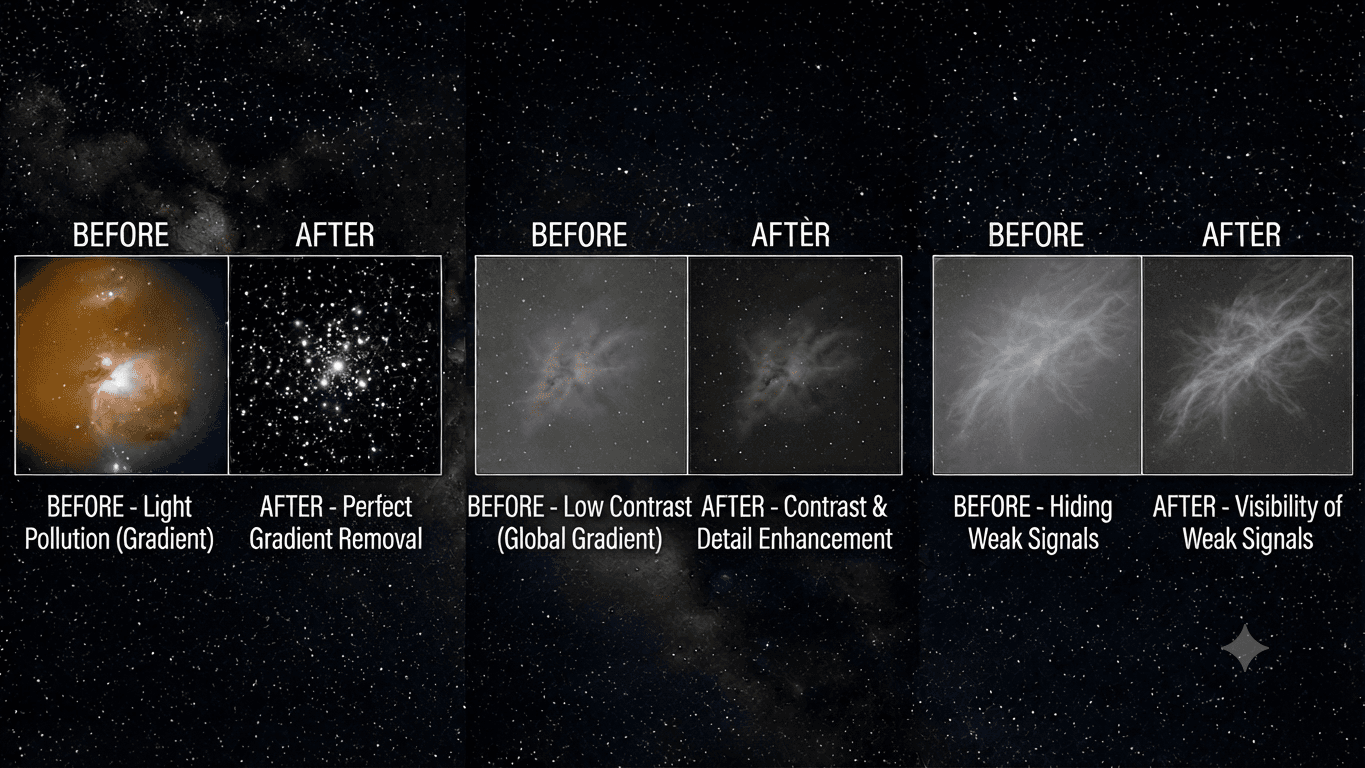
Second and independent point: the sky background carries a 6% tilted plane at 32.5 degrees, well modelled and with no rotational symmetry, so neither vignetting nor flat is at fault. That is cleanly handled at stacking. In short, one mechanical action to take, everything else is already there.
Priority actions
- Redo polar alignment and check autoguiding, targeting total RMS under 1 arcsec at this sampling
- Test 150-180s subs on a few frames to confirm the elongation really comes from tracking
- Plan a gradient extraction (GraXpert or DBE) after stacking for the 6% plane
- Keep stacking: with this sky and background, integration will pay off quickly on the faint filaments