Astrophotography diagnosis of NGC 6960: Sensor tilt and tracking drift
Raw300s10 juil. 2026
The Doc examined this image of NGC 6960 (raw, 300s). Estimated overall technical quality: 6/10. 2 defects found: Sensor tilt (severity 3/5), Tracking drift (severity 2/5).
&w=1920&q=75)
Info
- Cible
- NGC 6960
- Date
- 10 juil. 2026, 23:26
- Lune
- Gibbeuse croissante 83.4% (sous l'horizon)
- Site
- Bortle 2 · rural typique (VIIRS)
- Position
- 20h44m55s · +30°48'43"
Very favorable conditions: Bortle 2 gives a dark background and high SNR even on a single sub, confirmed by the deep black background of your sub. The Moon is below the horizon and 90 degrees from the target, so no lunar pollution to worry about. On an emission target like the Veil, this sky is ideal: you can extend total integration with no gradient risk, and the low background-to-black-point margin (e_margin 2.02) is normal here for narrowband imaging on a very dark background, not an underexposure to correct.
Setup
- Type d'image
- Brut
- Télescope
- EQMod Mount
- Caméra
- ZWO ASI585MM Pro
- Exposition
- 300s
- Phase de lune
- Dernier croissant (15 %)
- FOV
- 1.70°
Setup consistent with the target. At 375mm and 1.595 arcsec/px, sampling is comfortable and well matched to typical seeing (neither over- nor under-sampled), and the 1.70 degree field frames the western part of the Veil around 52 Cygni properly; the full complex would need a mosaic. Gain 252 on the ASI585MM does not saturate (0% clipped pixels) and -11.5C is healthy to control dark current. Offset 15 causes no dark clipping (0%), which is fine. The attention point is hardware rather than settings: the optical train shows a tilt to correct.
The diagnosis in detail
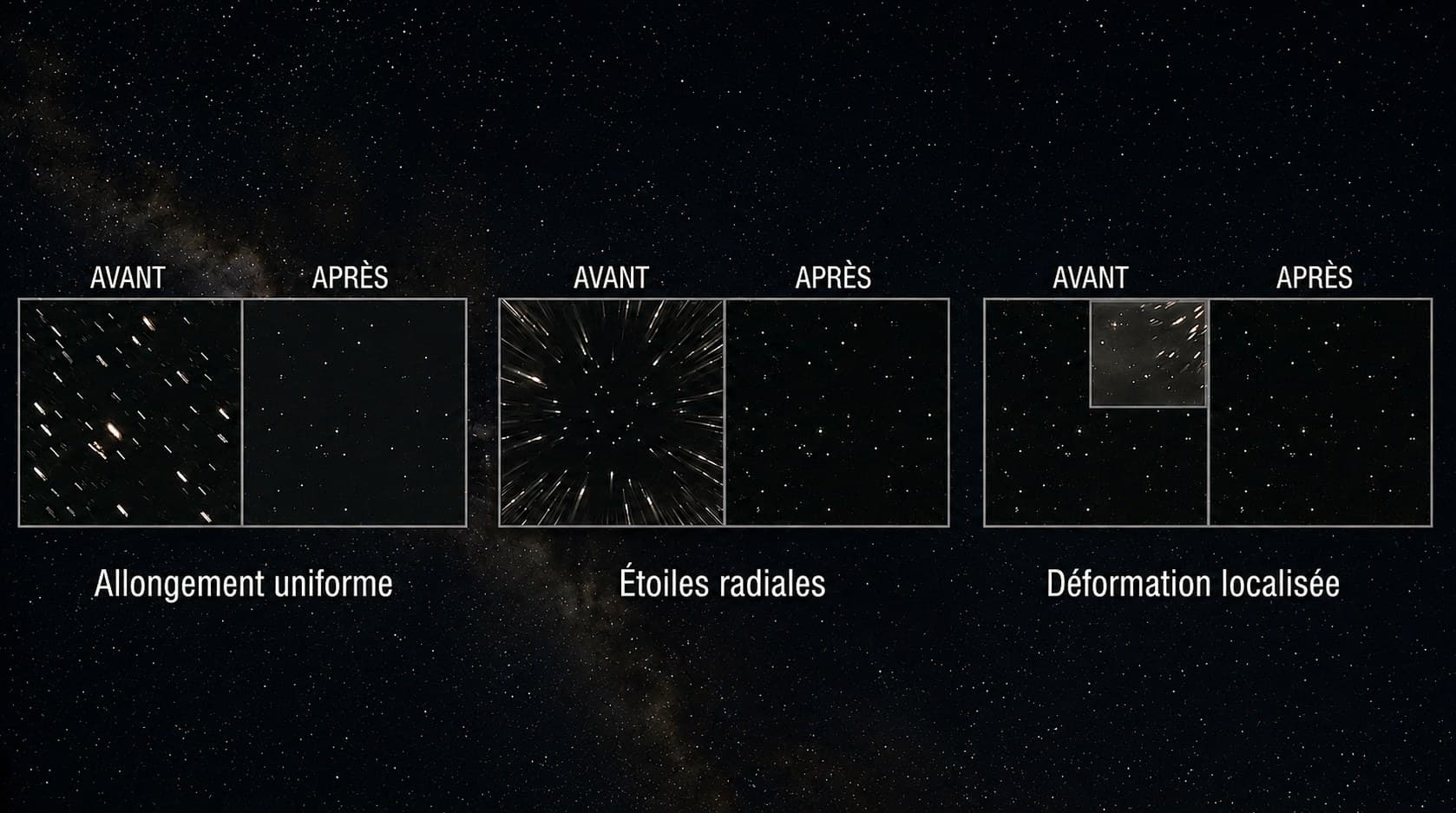
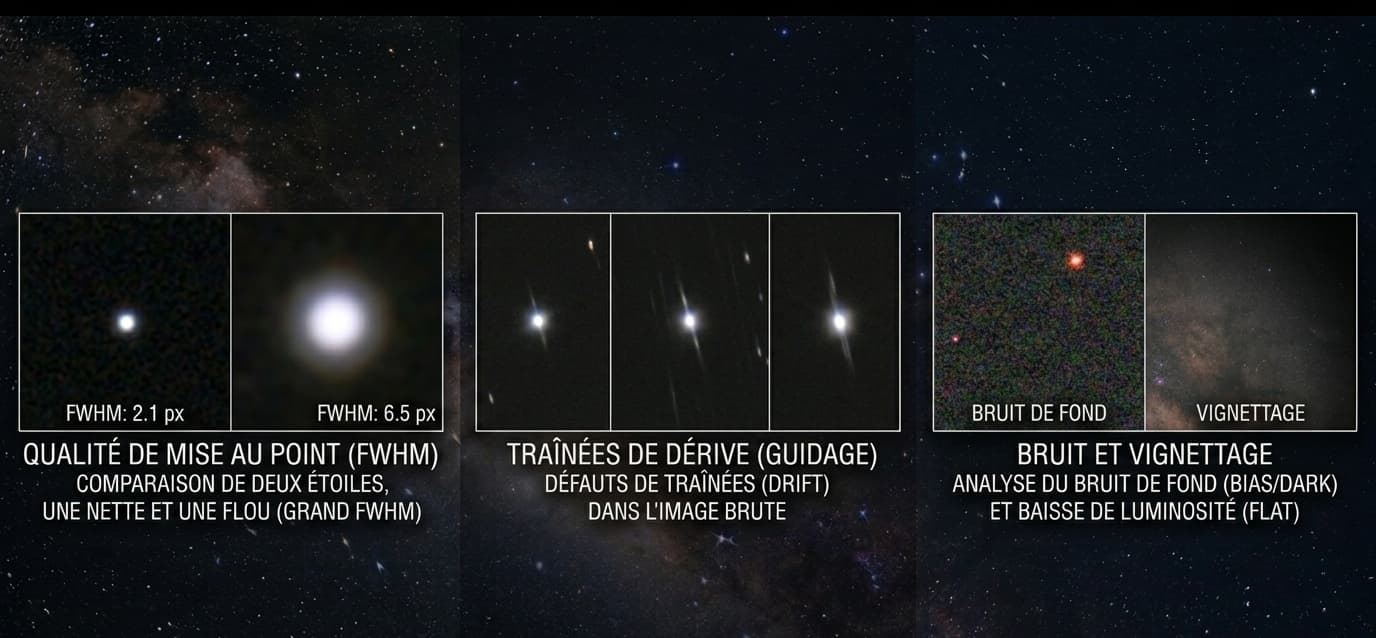
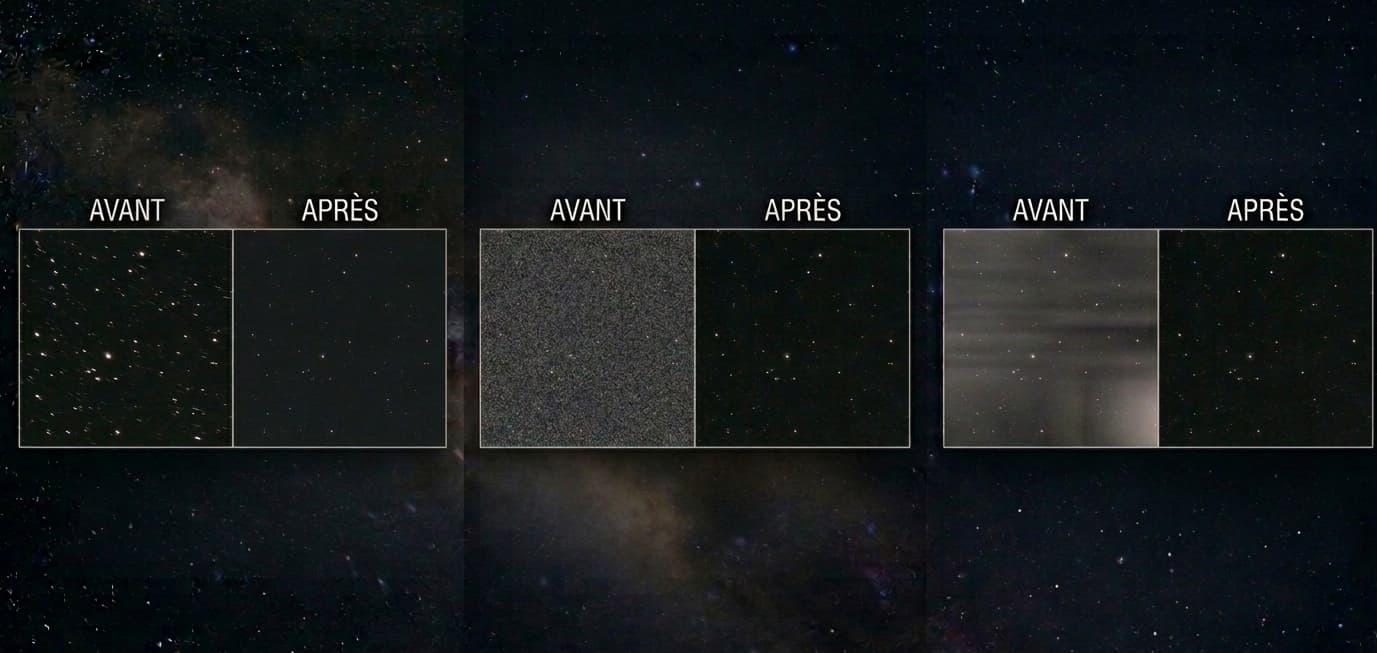
The sub is well made for a single frame: uniform sky background (background map nearly flat, only 3% variation, radial symmetry), no parasitic gradient, and nebulosity already well detached thanks to the Bortle 2 sky. The two flagged defects are purely instrumental and independent of each other. Sensor tilt is the more structural one: the PSF panel shows a sharp upper half (elong 1.1 to 1.2) against a lower half that drops off sharply (BL a large blob at FWHM 3.2, BR oval at elong 1.67), with a vertical asymmetry of 0.244, four times the horizontal one. This is a mechanical tilt of the focal plane on the vertical axis, to be corrected at the optical train, not in processing. Overlaid on it is a subtler tracking drift: elongation reaches the field center (C at 1.24) with a consistent direction across all zones (PA scattered by only 17 degrees), a signature of movement during the exposure rather than an optical aberration. In practice, fix the tilt first (immediate gain on corner uniformity), then tighten guiding to sharpen the central stars. Once both are addressed, this setup under this sky will yield a very high quality Veil master.
Priority actions
- Correct sensor tilt with a push-pull ring, iterating on the aberration inspector until top/bottom FWHM match
- Improve tracking (optimized autoguiding and refined polar alignment) to remove the drift visible at center
- Accumulate more 300s subs to fully exploit the Bortle 2 sky and raise SNR on the faint filaments