Astrophotography diagnosis of NGC7380: Sensor tilt and clipped stars
RawHOO 1 composite7680s
The Doc examined this image of NGC7380 (raw, HOO 1 composite, 7680s). Estimated overall technical quality: 6/10. 2 defects found: Sensor tilt (severity 3/5), Clipped stars (severity 2/5).
&w=1920&q=75)
Info
- Cible
- NGC7380
- Site
- Bortle 6 · banlieue dense (VIIRS)
- Position
- 0h48m48s · +56°36'00"
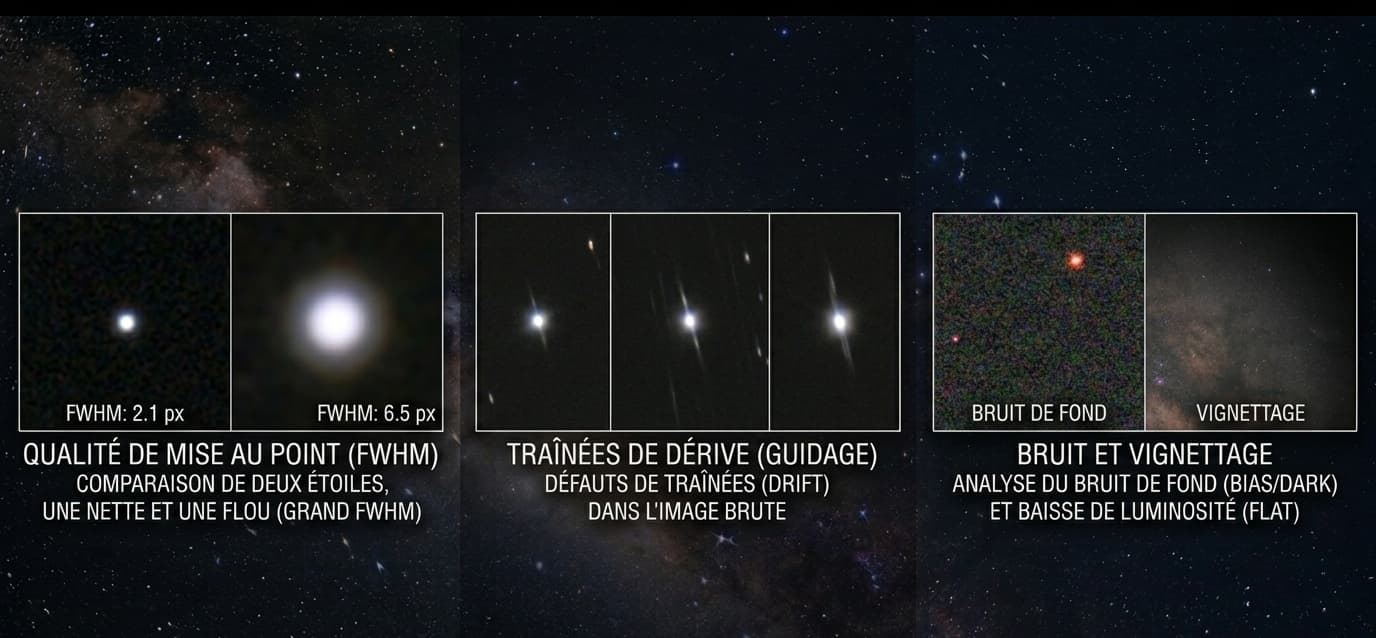
Decent conditions for this target: a 14% crescent and Bortle 6 remain manageable on an emission nebula shot in HOO, the narrowband filter rejecting most of the urban glow and faint moonlight. Seeing around 1.6" is good and consistent with the measured FWHM (~2.2" at center). Nothing here forces you to reschedule; in broadband RGB under this Bortle the verdict would differ, but HOO neutralizes most of the handicap.
Setup
- Type d'image
- Brut
- Télescope
- Skywatcher 200/800
- Caméra
- FUJIFILM XT-3
- Filtre
- HOO 1 composite
- Monture
- EQ6R
- Exposition
- 7680s
- Phase de lune
- Premier croissant (14 %)
- Seeing
- 1,6°
- FOV
- 1.00°
Setup consistent with the target. The 200/800 Newtonian gives a 1deg-wide field that frames NGC 7380 comfortably with room for the extended nebulosity. At 0.566"/px you are oversampled versus the 1.6" seeing (ideal closer to ~0.8"/px), which is not penalizing but adds no useful resolution and slightly raises per-pixel noise; a 2x bin in processing would be reasonable. HOO is a good choice to pull Ha and OIII from this HII region under suburban skies. Setup priority: fix the imaging-train tilt on the Newtonian.
The diagnosis in detail
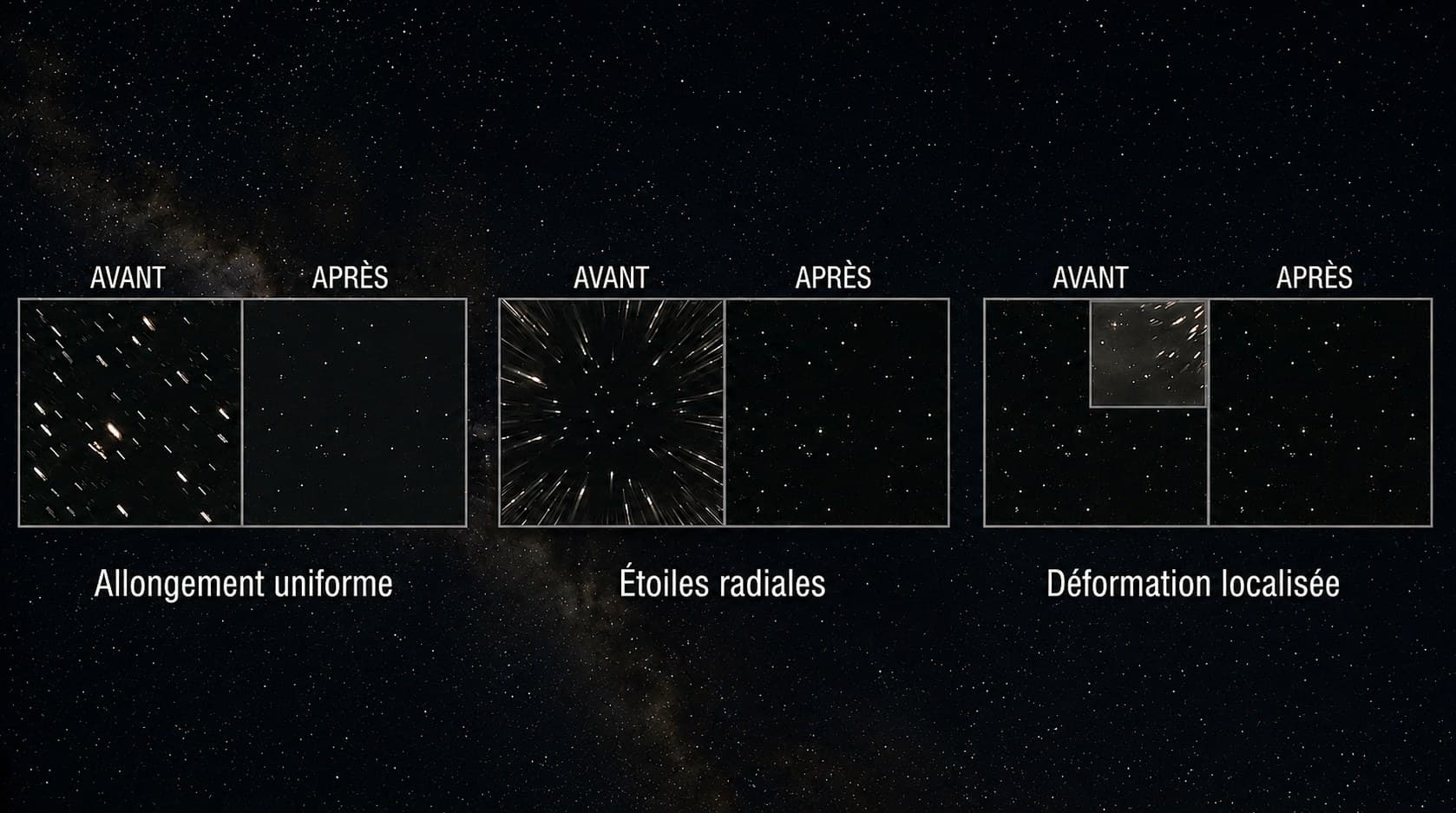
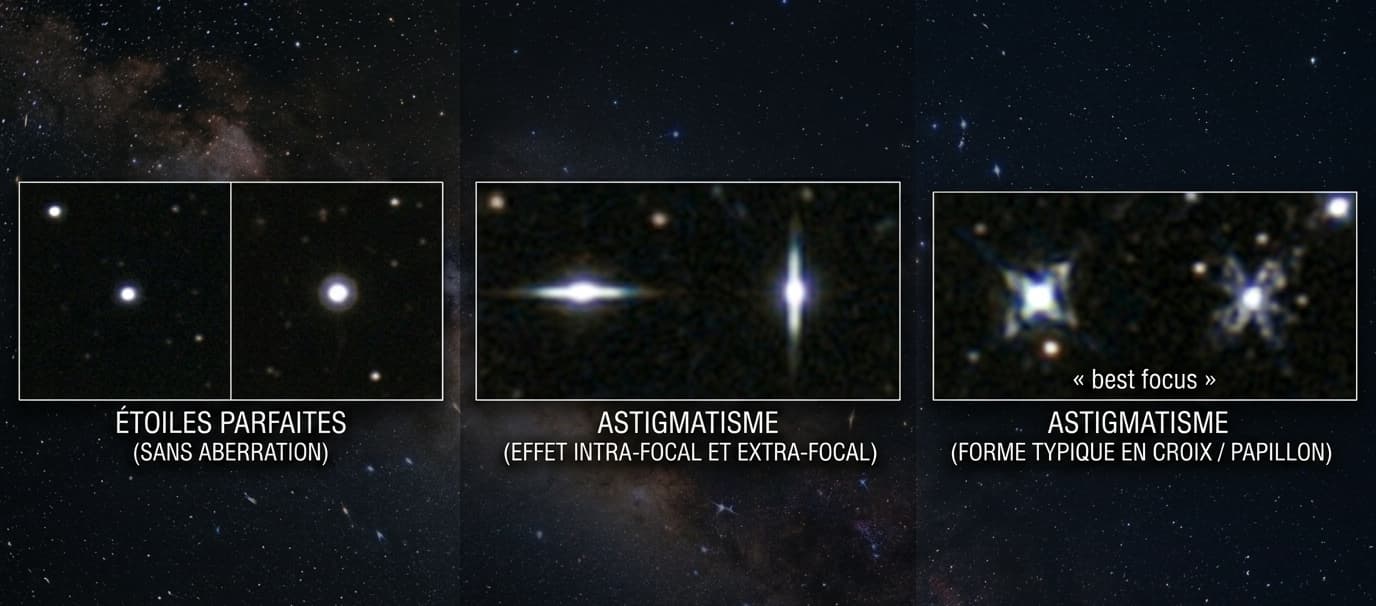
On this sub the star shape is good at center (elong 1.12, very close to the field floor of 1.09) and degrades toward the edges in a telling pattern: the top edge (1.41) and bottom-left corner (1.39) are clearly more stretched than the bottom-right corner (1.15), with a coherent elongation orientation (PA dispersion 9.4 deg). This one-axis asymmetry, while central FWHM stays low, matches a tilted sensor plane rather than symmetric backfocus field curvature or pure radial coma. It is the only true instrumental defect and is fully correctable by a mechanical adjustment of the imaging train.
The rest is healthy. The sky background is radially symmetric with only +7% edge darkening (normal optical vignetting, to be removed by flats) and no significant oriented gradient; nothing to flag on the sky for this sub. A few bright stars have clipped cores, expected when the exposure is set for faint nebulosity and cured with complementary short exposures.
The sky/black-point margin e_margin=2.35 is low in absolute terms, but that is normal for a narrowband sub where the background stays dark: do not read it as underexposure. Most of the gain will come from stacking and from fixing the tilt before adding more subs.
Priority actions
- Fix the sensor tilt: evenly retighten the imaging train and, if needed, add an adjustable tilt plate, iterating with the aberration inspector until opposite-corner elongation is balanced
- Add short exposures to rebuild the clipped bright-star cores (stellar HDR at stacking)
- Shoot flats to remove the optical vignetting (+7%) and stack the full series to build SNR