Astrophotography diagnosis of NGC 7023: Sensor tilt and satellite trail
RawL300s14 sept. 2026
The Doc examined this image of NGC 7023 (raw, L, 300s). Estimated overall technical quality: 7/10. 2 defects found: Sensor tilt (severity 3/5), Satellite trail (severity 1/5).
&w=1920&q=75)
Info
- Cible
- NGC 7023
- Date
- 14 sept. 2026, 19:18
- Lune
- Gibbeuse décroissante 85.6% (sous l'horizon)
- Site
- Bortle 2 · rural typique (VIIRS)
- Position
- 21h01m35s · +68°09'15"
Excellent conditions. Bortle 2 is the best possible ground for NGC 7023, a reflection nebula in broadband light: no light-pollution filter can help on that kind of target, only a dark sky can, and you have it. The 85.6 percent waning gibbous Moon was below the horizon during the exposure, 112.5 degrees from the target: its contribution is nil. The measured background confirms that dark sky, with a background-to-black-point margin of only 2.19, so no light-pollution flooding. In short, nothing in the conditions limits this acquisition: this is the ideal moment to pile up integration on the faint outer extensions of the Iris and on the surrounding IFN.
Setup
- Type d'image
- Brut
- Télescope
- Takahashi FSQ 530@F\5.0
- Caméra
- PlayerOne CCD Zeus 455M PRO
- Filtre
- L
- Exposition
- 300s
- Phase de lune
- Premier croissant (10 %)
- FOV
- 3.89°
Coherent setup, with one framing reservation. The 1.463 arcsec/px sampling is comfortable, and the central FWHM of 1.74 px confirms it: you are slightly undersampled relative to what the optics deliver, but that is a healthy compromise on a 9576x6388 sensor. On the other hand, the FSQ at 530 mm over a 3.89 degree field makes NGC 7023 tiny in the center: the nebula spans less than 5 percent of the frame width. That framing makes sense if you are after the whole Cepheus dust complex and its IFN, otherwise a longer focal length would serve the target better. On the settings side, gain 125 and offset 50 are healthy, with no black clipping. Two things to watch: the background-to-black-point margin of 2.19 shows you are not sky-limited, and above all the sensor temperature at 0 degrees, which should come down toward -10 to limit dark current.
The diagnosis in detail
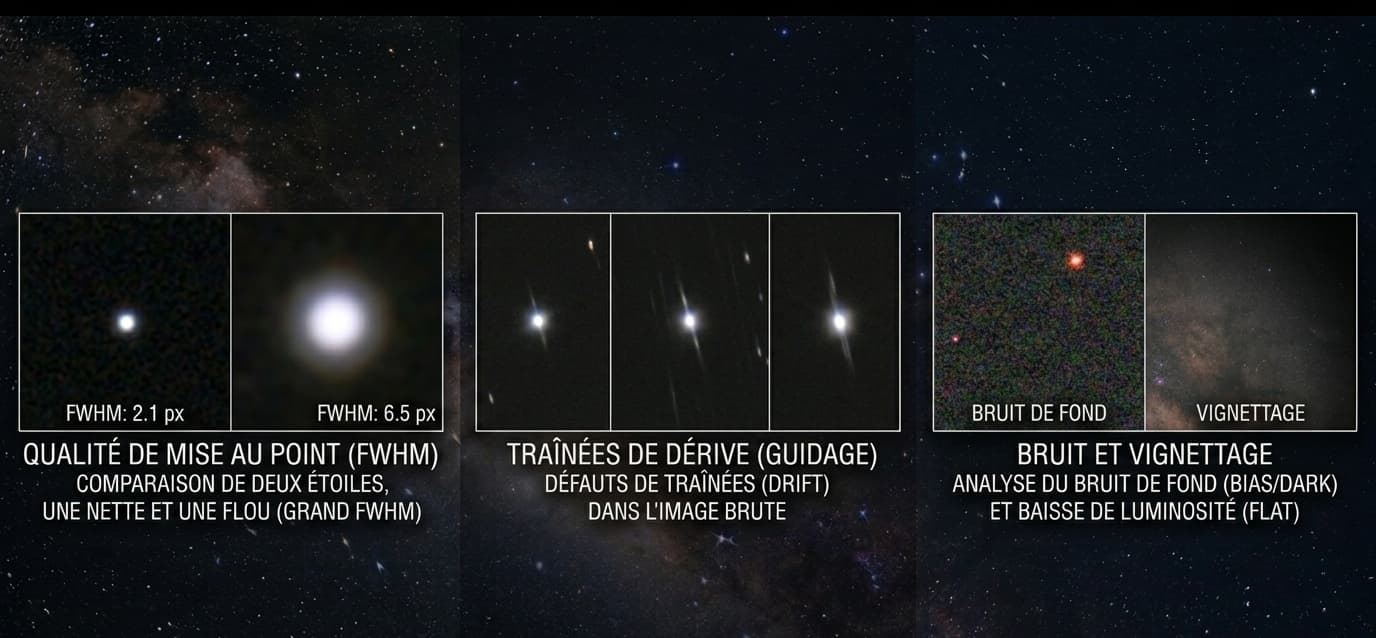
This sub is technically of a good standard. The heart of the field is excellent: FWHM 1.74/1.70 px and 1.02 elongation at the center, meaning tracking over 300 seconds is perfect, focus is spot on and seeing was good. No sign of drift, periodic error or guiding oscillation, and the 36.5 degree PA scatter between zones confirms the residual elongation is not directional and therefore not mount-related.
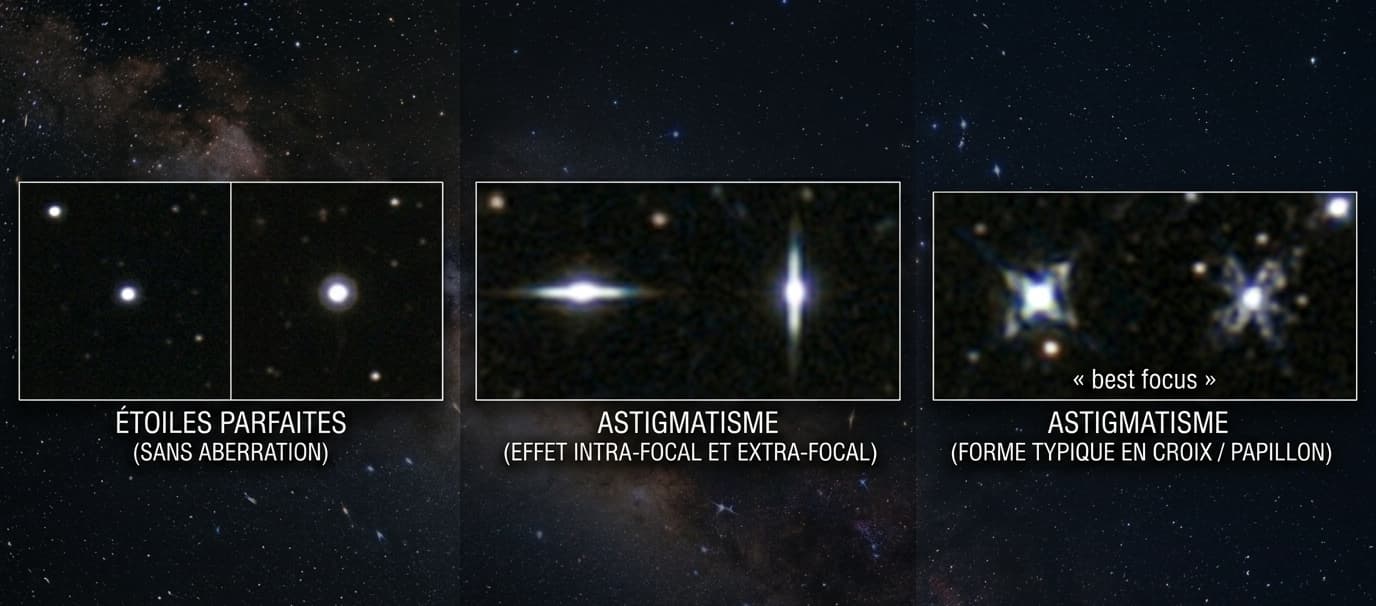
The only instrumental defect is an imaging-train tilt. The panel reads clearly: both left corners climb to 2.5 and 2.7 px FWHM with elongations of 1.30 to 1.36, while the three right-hand zones stay between 1.06 and 1.11. The asymmetry is horizontal (0.135 against 0.06 vertically) and the center stays sharp, which rules out a backfocus error (it would degrade all four corners equally) as well as residual field curvature. This is a focal plane slightly tipped along the left-right axis, typically a few hundredths of a millimeter to recover in the couplings.
The background shows a 31 percent radial falloff toward the edges, symmetric and with no preferred orientation: that is normal optical vignetting on an uncalibrated sub, which flats will correct entirely. Nothing to fix there. The satellite trails will vanish under sigma rejection.
Priority actions
- Correct the imaging-train tilt on the left side: evenly retighten the threaded couplings, then re-measure with the aberration inspector
- Bring the sensor temperature down to -10 degrees to reduce dark current (currently 0 degrees)
- Shoot a proper flat set to correct the 31 percent radial falloff measured at the edges
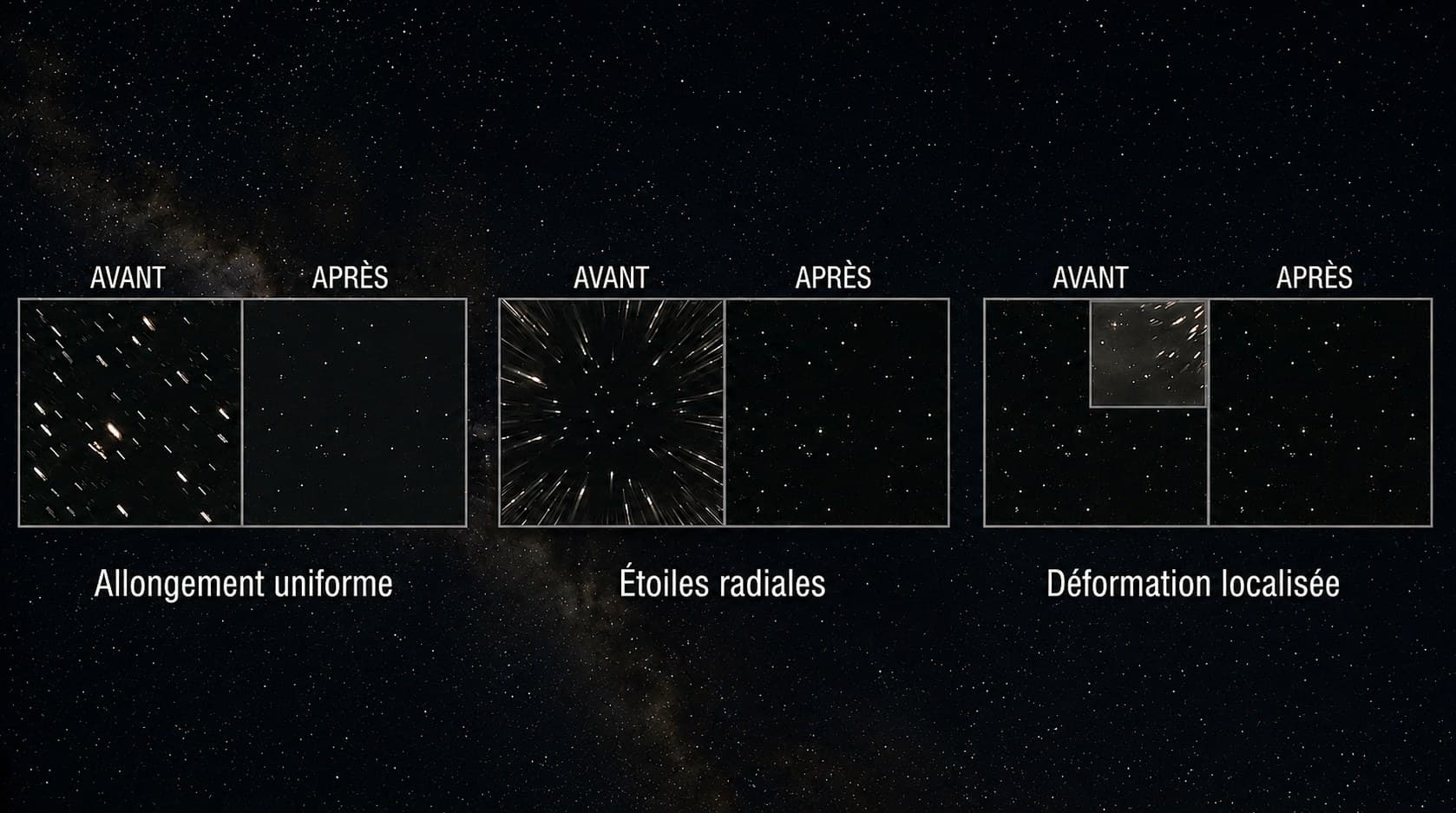
- Stack at least 15 frames with dithering and sigma rejection to remove the satellite trails
- Consider a longer focal length if NGC 7023 itself is the target, as the 3.89 degree field leaves it very small