Astrophotography diagnosis of NGC 7635uhc: Light pollution gradient, backfocus error and 2 others
MasterIRUV83×60s24 sept. 2026
The Doc examined this image of NGC 7635uhc (master, IRUV, 83×60s). Estimated overall technical quality: 5/10. 4 defects found: Light pollution gradient (severity 4/5), Backfocus error (severity 3/5), Noise / underexposure (severity 3/5), Clipped stars (severity 2/5).

Info
- Cible
- NGC 7635uhc
- Date
- 24 sept. 2026, 22:48
- Lune
- Croissant décroissant 3.6% (33.7° d'alt., 69.4° de la cible)
- Site
- Bortle 3 · rural peu pollué (VIIRS)
- Position
- 23h20m08s · +61°22'45"
Bortle 3 site: sky background conditions are excellent on paper, yet the measured gradient reaches 42%. The declared lunar context is contradictory (gibbous 97% on one side, 3.6% crescent on the other): if the Moon really was at 3.6% illumination it contributes nothing, and the gradient then comes from a ground source toward 250 degrees or from a target low on the horizon. If instead the Moon was gibbous at 33.7 degrees altitude and 69 degrees from the target, it alone explains much of the background. In that case a dual-band H-alpha/OIII filter on NGC 7635, an emission nebula, would have protected contrast far better than a plain IRUV.
Setup
- Type d'image
- Master
- Télescope
- EQMod Mount
- Caméra
- ZWO ASI2600MC Pro
- Filtre
- IRUV
- Monture
- EQ6 pro
- Exposition
- 83×60s
- Phase de lune
- Gibbeuse croissante (97 %)
- Notes
- Corrigé DOF
- FOV
- 53.8'
The setup is sound in principle but mis-sized on two points. At 1482 mm the 0.90 degree field frames NGC 7635 with room to spare, so framing calls for no criticism. Sampling at 0.523 arcsec/px is heavily oversampled though: under typical 2 to 3 arcsec seeing, the central FWHM of 4.75 px corresponds to about 2.5 arcsec, so the sensor is mostly resolving noise. Software 2x2 binning at stacking would return SNR with no real loss of detail. On settings, gain 120 and -10 C are healthy and offset 50 does not clip, but the 60s exposure gives e_margin=1.96: you are not sky-limited, move to 180-300s since the mount guides. On an emission target, a dual-band filter would be more relevant than the IRUV.
The diagnosis in detail
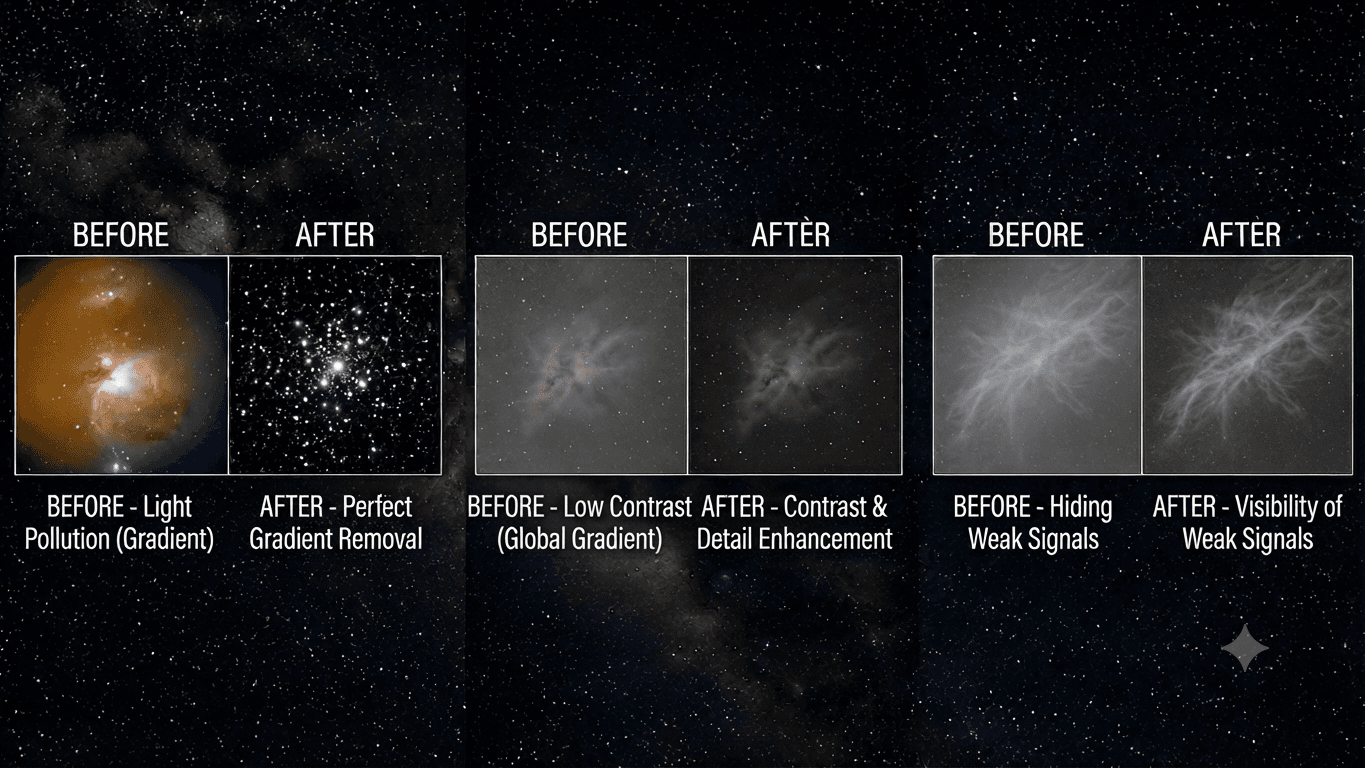
Two families of problems overlap here, and they do not call for the same remedy. The first is a sky and signal-budget issue: the measured 42% gradient (plane R2=0.81, 4.71 dominance over the radial term) crushes background contrast, and underneath there is little to reveal anyway, since 83 subs of 60s at e_margin=1.96 leave the frames far from sky-limited. The visible result: the DSS shows an H-alpha complex filling half the field while your master only brings out the bubble and two filaments. The gradient can be removed in post, the missing signal cannot.
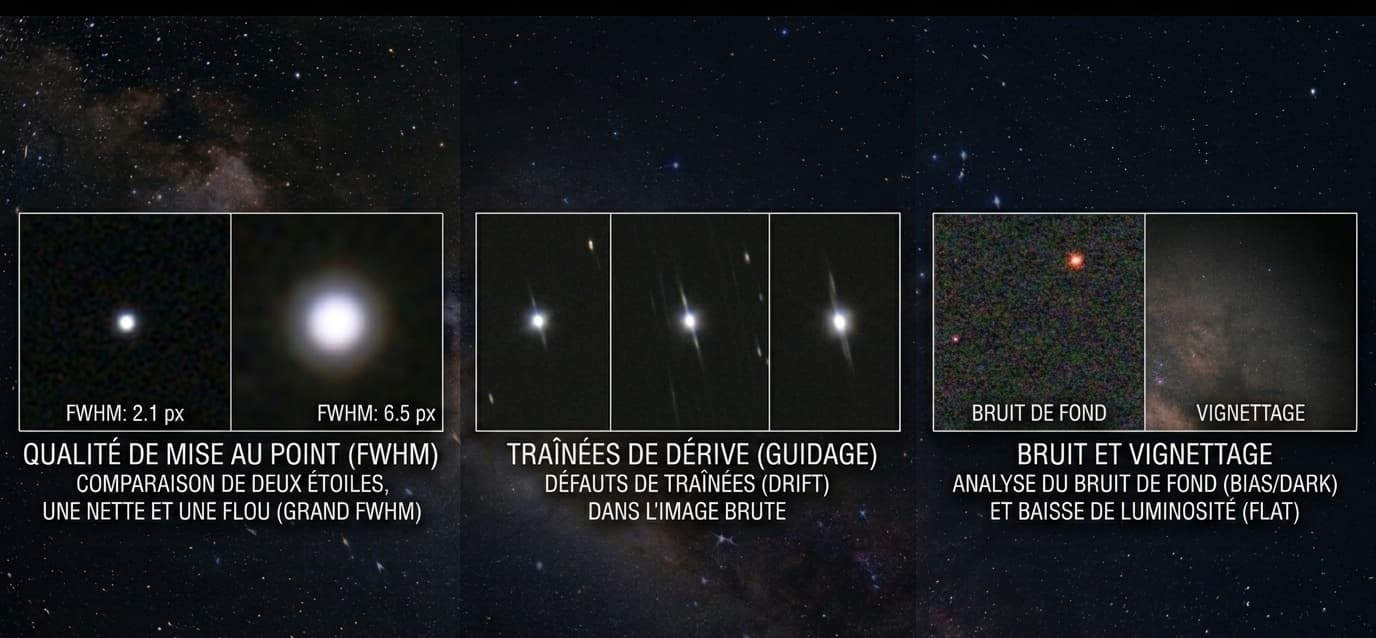
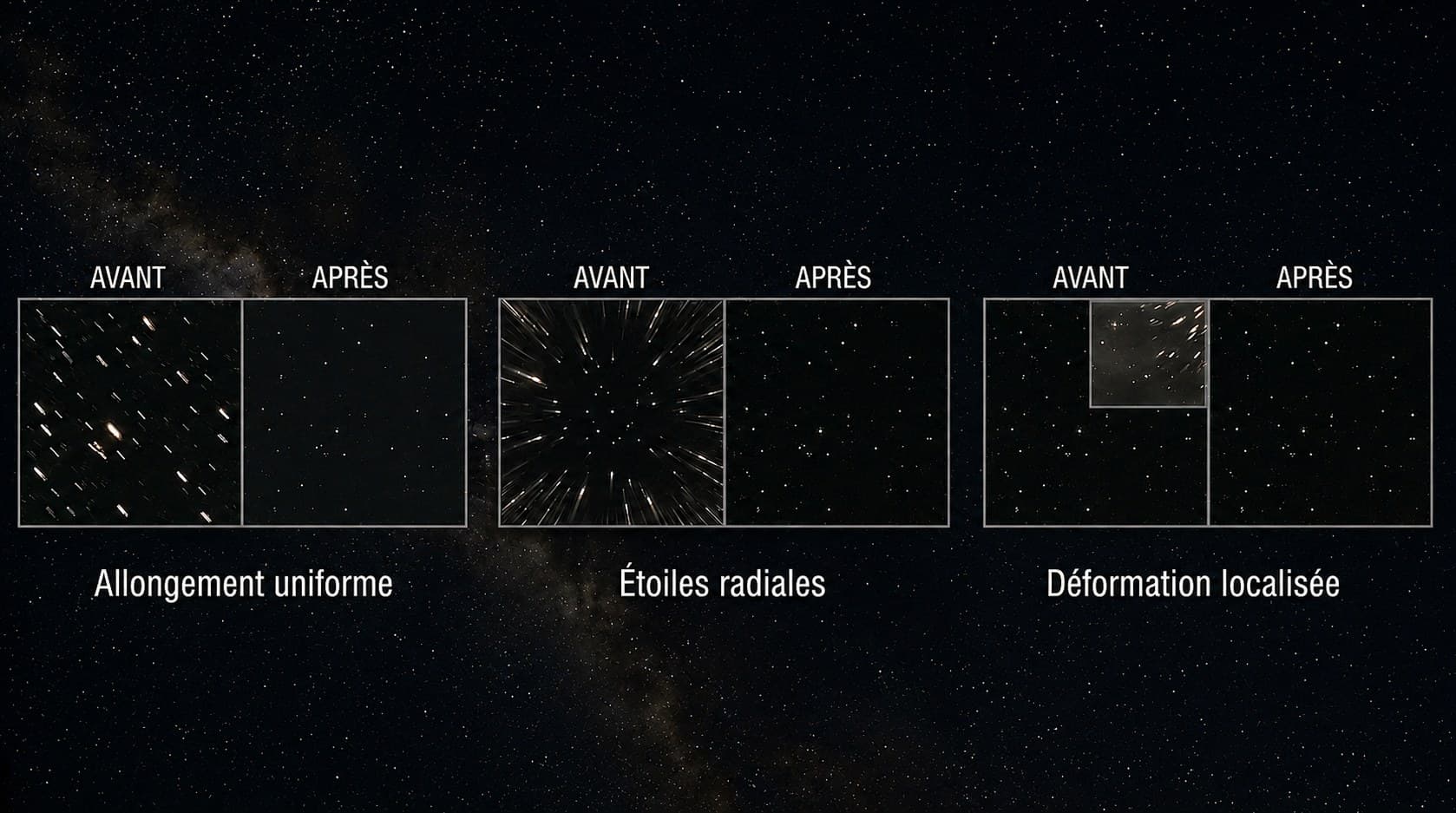
The second family is optical. The centre is clean (FWHM 4.75/4.22, elong 1.13 against a 1.06 field floor), so neither tracking nor focus is at fault: guiding holds well over 60s. But FWHM rises to 7.21 px at TL and the corner/centre ratio reaches 1.275 with oval stars in all four corners, the classic signature of imperfect spacing or residual field curvature. Since the upper left corner is noticeably worse than the upper right, a small tilt component may add to it: check that only after optimising backfocus, otherwise you chase two variables at once.
Finally, a few bright stars have clipped colourless cores, a minor point that a short-exposure set would fix if you want coloured stars.
Priority actions
- Lengthen subs to 180-300s and target 5 to 10 cumulative hours on NGC 7635 to bring out the extended H-alpha
- Remove the 42% gradient with GraXpert or DBE before any other processing step
- Optimise backfocus with 0.5 then 0.2 mm shims and re-check corner FWHM
- Consider a dual-band H-alpha/OIII filter rather than the IRUV on this emission nebula
- Add a short series of 5-15s exposures to rebuild the saturated star cores