Astrophotography diagnosis of NGC281: Sensor tilt, clipped stars and 1 other
ProcessedANTLIA tri band RGB Ultra 270x300s
The Doc examined this image of NGC281 (processed, ANTLIA tri band RGB Ultra 2, 70x300s). Estimated overall technical quality: 7/10. 3 defects found: Sensor tilt (severity 3/5), Clipped stars (severity 2/5), Light pollution gradient (severity 2/5).

Info
- Cible
- NGC281
- Site
- Bortle 7 · périurbain pollué (saisi)
- Position
- 0h42m48s · +56°36'00"
Conditions clearly unfavorable on paper: Bortle 7 with an 85% Moon means a very bright sky background and heavy scattering. Fortunately NGC 281 is a strong Ha emission nebula, and the Antlia tri-band limits the damage, which explains why the signal is well present nonetheless. Still, the measured background to black point margin (e_margin 1.7) and the 14% gradient directly reflect that light pressure. With 70x300s you compensate through integration, but the same target under a Moon below 30% would give you noticeably better contrast and a far easier background to flatten. For wideband RGB widefield work, these conditions would be prohibitive.
Setup
- Type d'image
- Traitée
- Télescope
- skywatcher 80ED avec reducteur 0.85x
- Caméra
- ZWO ASI2600MC AIR
- Filtre
- ANTLIA tri band RGB Ultra 2
- Monture
- MLAStro SAL-33
- Exposition
- 70x300s
- Phase de lune
- 85%
- FOV
- 1.00°
A coherent and well matched combination. The 80ED with 0.85x reducer gives a 1.00 degree field, which frames NGC 281 comfortably: the nebula fills roughly the central third with margin all around, with no risk of cutting the outer extensions. The ASI2600MC behind this focal length stays in a reasonable sampling range for typical seeing. The Antlia tri-band is the right choice on an emission target under Bortle 7 and moonlight, it is what saves the session. The weak point is not optical in the glass sense but mechanical: the reducer to camera chain is not perfectly square, and it is precisely the reducer that makes the assembly sensitive to tilt and backfocus distance. 300s subs are consistent with the narrow filter, the low measured background margin being normal with a tri-band.
The diagnosis in detail
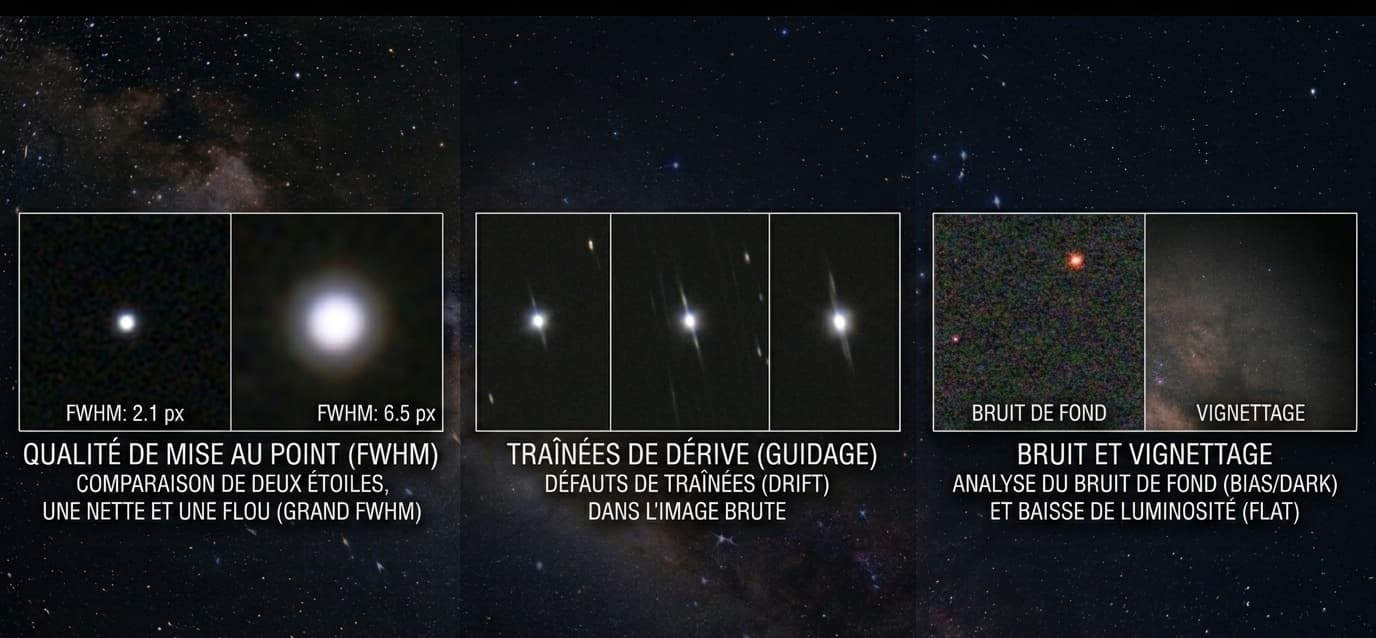
The main diagnosis is mechanical. The Moffat measurements show a very clean center at 3.94/3.62 px FWHM, then a degradation that is not symmetric: the vertical asymmetry (0.081) is six times the horizontal one (0.013), and the top of the field (T at 4.54 px) stays clearly better than the bottom (BL 5.57, BR 5.64). A backfocus error alone would degrade all four corners evenly, which is not the case here. This is the signature of tilt in the imaging train, most likely at the 0.85x reducer connection, a component that makes the assembly sensitive to both squareness and spacing.
On the tracking side, nothing to report: center elongation stays at 1.09 against a field floor of 1.02, PA dispersion is 37.7 degrees, the stars are round. The mount and autoguiding are doing their job on 300s subs.
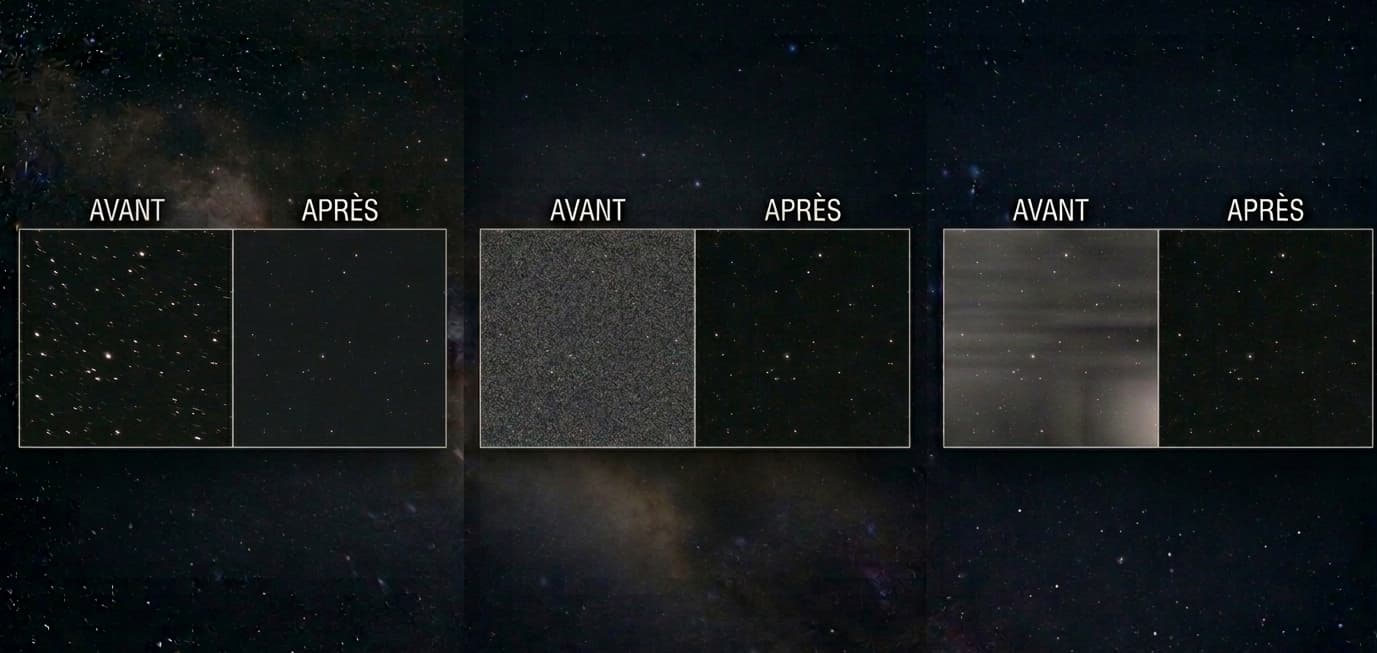
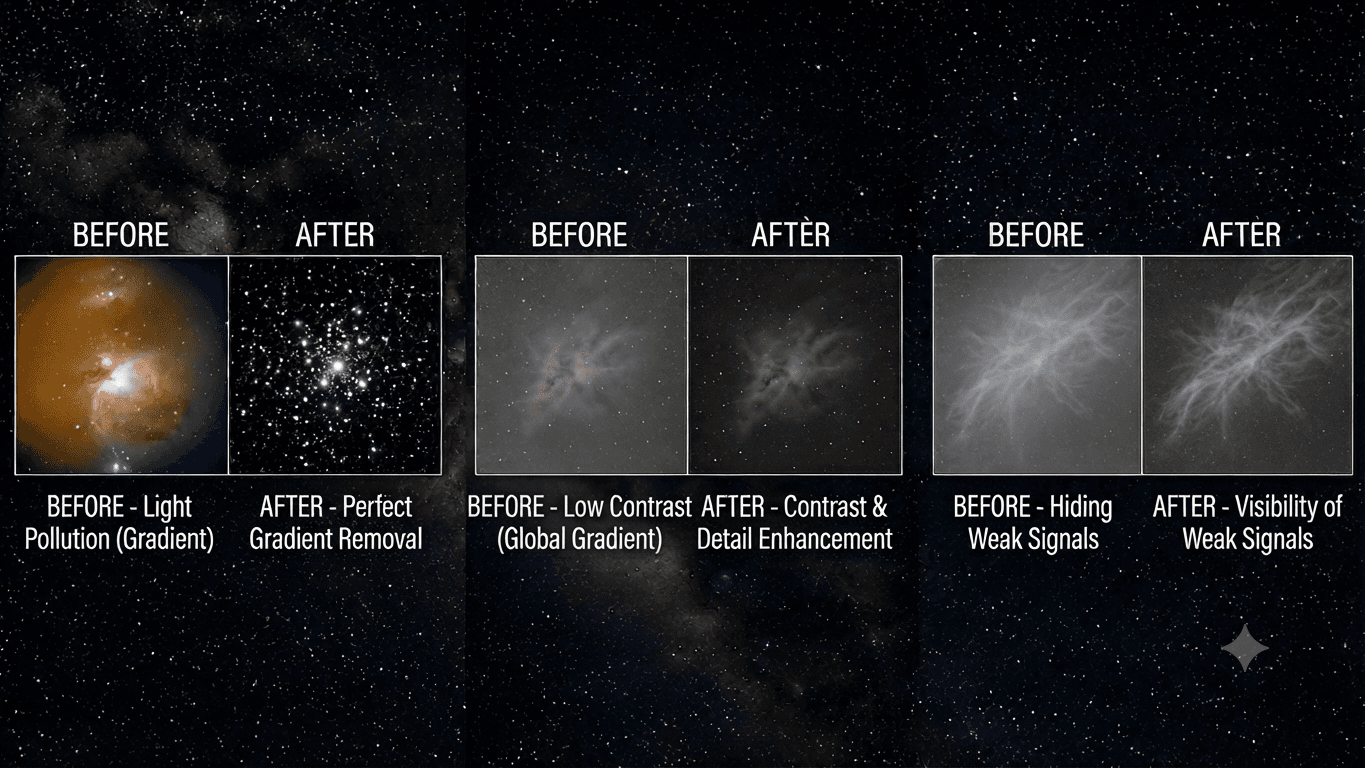
The second axis is the sky background. The 14% linear gradient oriented 218 degrees is indeed a plane (R2=0.74) and not vignetting, the radial component being nearly nil. It follows directly from the conditions and from slightly too timid a gradient removal. It is the easiest defect to recover, working on the linear data. The few clipped star cores remain anecdotal given the measured saturation rate.
Priority actions
- Fix the imaging train tilt: tighten and check the reducer to camera joint, then adjust with a tilt plate until top and bottom FWHM match
- Precisely verify the 0.85x reducer backfocus distance using rigid spacers
- Redo the gradient removal on the linear image (GraXpert AI or GradientCorrection) with sample points placed outside the nebula
- Add a few short 10-30s subs to rebuild the bright star cores in HDR
- Favor upcoming sessions with the Moon below 30% to gain contrast on the faint outer extensions