Astrophotography diagnosis of NGC7023: Astigmatism, clipped stars and 1 other
ProcessedUV/IR90x120s
The Doc examined this image of NGC7023 (processed, UV/IR, 90x120s). Estimated overall technical quality: 7/10. 3 defects found: Astigmatism (severity 2/5), Clipped stars (severity 2/5), Satellite trail (severity 1/5).
&w=1920&q=75)
Info
- Cible
- NGC7023
- Position
- 21h03m12s · +68°10'12"
35% crescent: moderate impact on a reflection nebula like NGC 7023, which stays sensitive to sky background since it is broadband (UV/IR). The background map shows only a very faint gradient (4% amplitude) and a near-symmetric profile, signs of a decent sky and good background control in processing. No clear lunar signature. To push the faint nebulosity further, favor a moonless night; the blue reflection and IFN will gain contrast.
Setup
- Type d'image
- Traitée
- Télescope
- 203/1200 bresser
- Caméra
- SV405cc
- Filtre
- UV/IR
- Monture
- EQ6-R
- Exposition
- 90x120s
- Phase de lune
- Premier croissant (35 %)
- Seeing
- 3
- FOV
- 48.0'
The 203/1200 Newtonian with the SV405cc gives tight sampling (about 0.65"/px) and a 0.80 deg field that comfortably frames NGC 7023, well centered. At this sampling the ~6 px FWHM (~4") mostly reflects seeing 3 and edge astigmatism rather than a tracking issue: the EQ6-R holds well (center elong 1.06). The broadband UV/IR filter is consistent for this reflection target. e_margin 2.2 means a background barely lifted off the black point: longer or more numerous subs would help the faint extensions.
The diagnosis in detail
The strength of this image is the rendering of the medium: the dark swirls and IFN filling the field match the structure seen on the DSS, so this is not a gradient or a background artifact. The background measurement confirms it (only 4% gradient, radial symmetry); no calibration defect or residual vignetting to report.
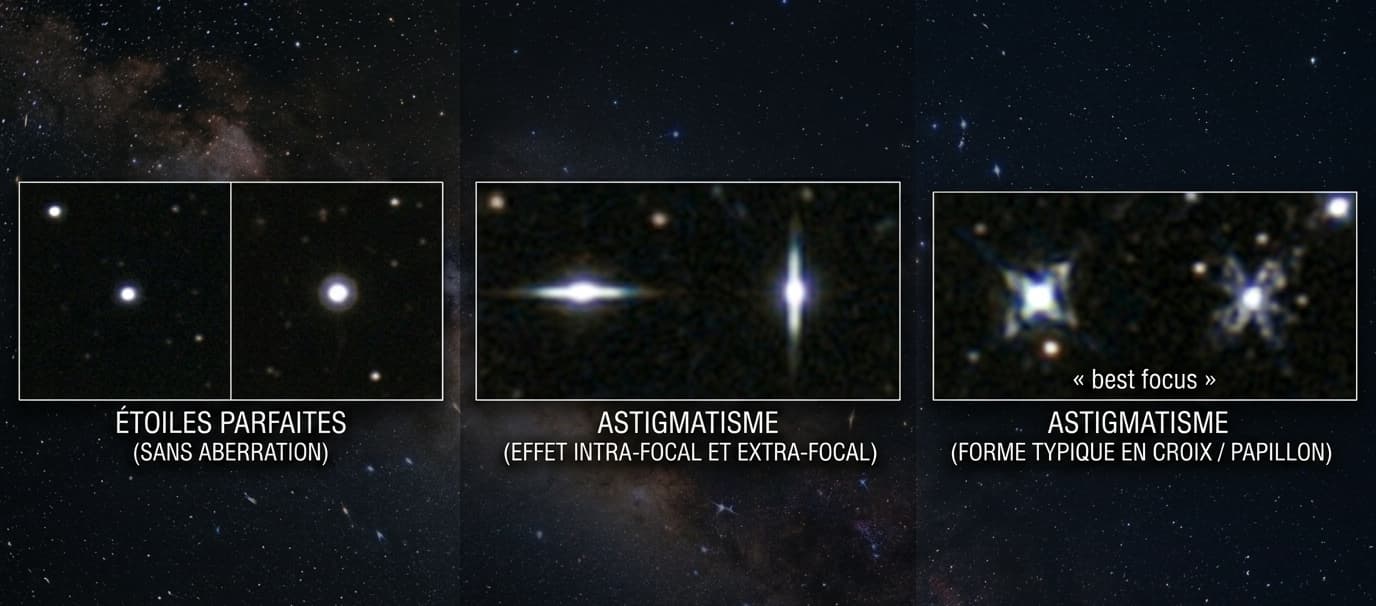
On stars, the center is sharp (elong 1.06, FWHM 6 px consistent with seeing) but the inspector shows elongation rising toward the edges without FWHM increase, especially in the bottom-left corner: this is mild field astigmatism, to address via collimation and corrector backfocus. Tracking is healthy, no drift or oscillation.
The two remaining cosmetic points are a thin residual satellite trail in the lower half, to remove with better integration rejection, and clipping of the brightest stars (including the illuminating star), recoverable with a short-exposure set. Nothing that seriously degrades the result.
Priority actions
- Refine collimation and corrector backfocus to reduce edge astigmatism
- Strengthen integration rejection to erase the residual satellite trail
- Add short exposures (5-15s) to rebuild the cores of the clipped bright stars
- Accumulate more integration under a moonless sky to better bring out the IFN