Astrophotography diagnosis of Quintet de Stephen: Light pollution gradient, sensor tilt and 2 others
ProcessedlRVB4 x 22 x 10 minutes
The Doc examined this image of Quintet de Stephen (processed, lRVB, 4 x 22 x 10 minutes). Estimated overall technical quality: 7/10. 4 defects found: Light pollution gradient (severity 3/5), Sensor tilt (severity 2/5), Clipped stars (severity 2/5), Background chroma noise (severity 2/5).
&w=1920&q=75)
Info
- Cible
- Quintet de Stephen
- Site
- Bortle 5 · banlieue résidentielle (VIIRS)
- Position
- 22h37m12s · +34°17'60"
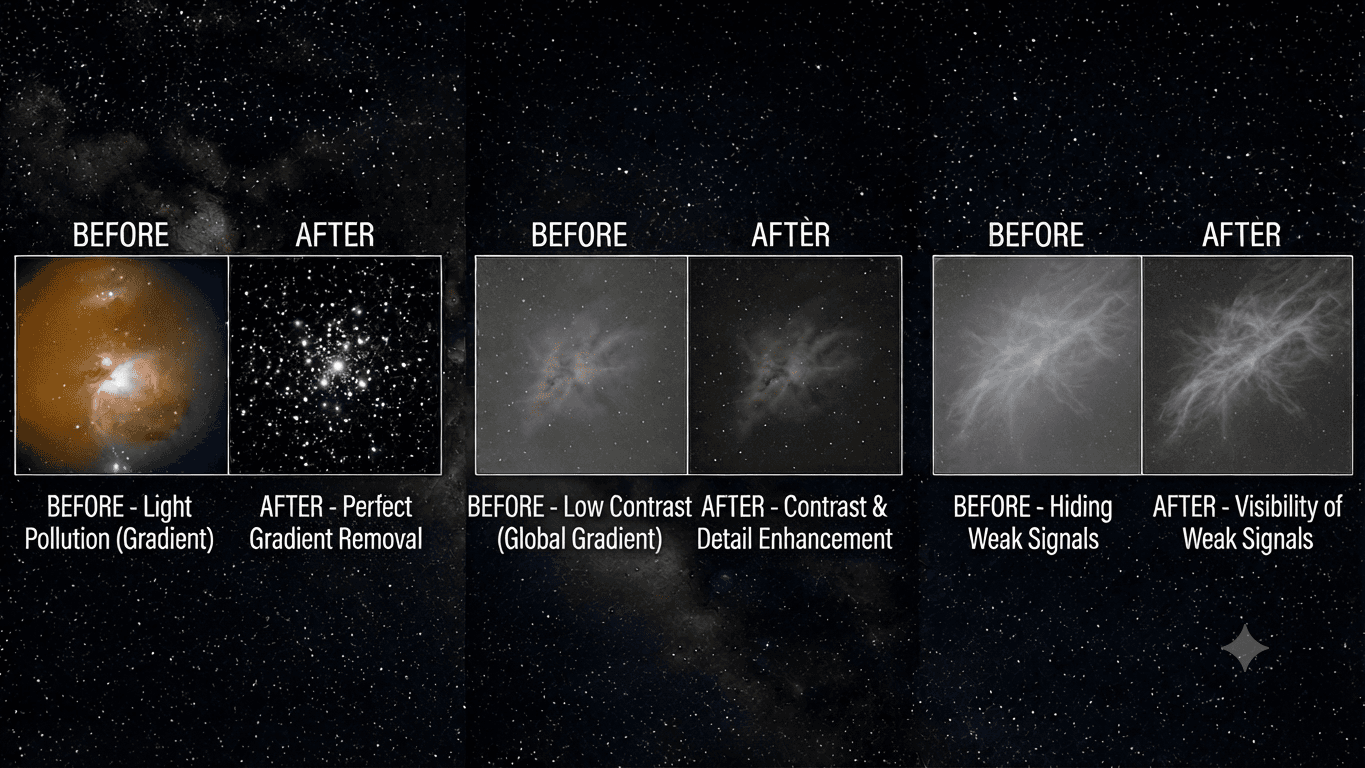
Conditions were rather favourable: a last crescent at 8 percent illumination, meaning a negligible Moon adding no bluish veil to the field. Bortle 5 is the real limiting factor here, since Stephan's Quintet and NGC 7331 are faint broadband targets with no emission lines a narrowband filter could exploit. That is exactly the context producing the 216 percent gradient amplitude measured: urban sky background largely dominates the faint galactic halo signal. Under such a sky, integration time is the only real answer, and careful gradient extraction on the linear master is mandatory before any stretch.
Setup
- Type d'image
- Traitée
- Télescope
- CDK 12.5" planewave
- Caméra
- Moravian C4 monochrome
- Filtre
- lRVB
- Monture
- Paramount MX+
- Exposition
- 4 x 22 x 10 minutes
- Phase de lune
- Dernier croissant (8 %)
- FOV
- 1.20°
The setup is very coherent with the target: a 12.5 inch CDK on a Paramount MX+ is exactly the tool for a compact group as small as Stephan's Quintet, and the 1.20 degree field conveniently places NGC 7331 in the same frame, which the composition uses well. Tracking confirms the mount's quality, stars staying round at centre over ten-minute exposures. The measured FWHM around 8 px at centre does however suggest slight oversampling or average seeing on this session, worth watching. On the acquisition side, the background to black point margin of 1.39 is low, a sign the stretch clamped the black point more than needed.
The diagnosis in detail
The dominant diagnosis is a sky background issue, not an optical or mechanical one. The plane measured on the illumination surface shows 216 percent amplitude with an R2 of 0.96 and an orientation of 225 degrees, that is a clean diagonal ramp running from the brighter top-left corner toward the bottom-right. The plane to radial ratio of 44 rules out vignetting: this is not a flat problem, it is residual light pollution that was poorly extracted. Since the field holds no extended nebulosity, no real structure can be mistaken for this ramp.
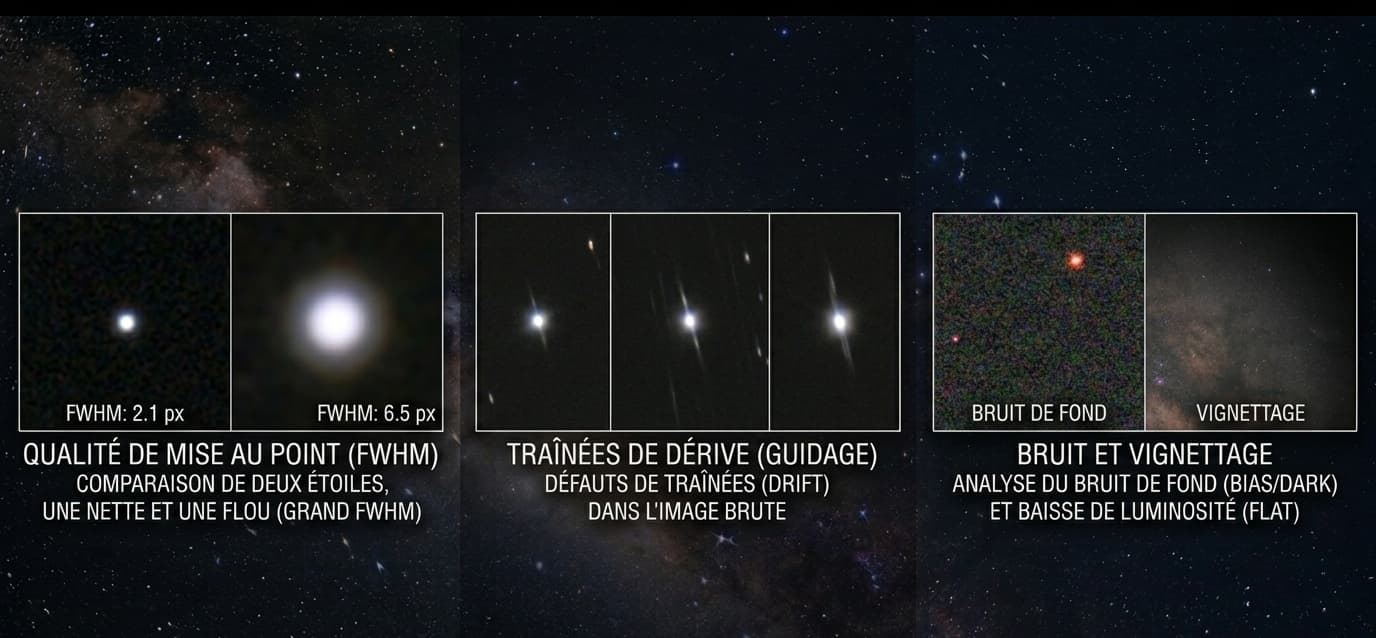
On star shape the Moffat measurement is reassuring: centre elongation of 1.05 against a field floor of 1.03, PA dispersion of 39 degrees hence no preferred direction, which rules out any tracking defect despite ten-minute subs. However the horizontal FWHM asymmetry (0.167 versus 0.035 vertical) and a corner to centre ratio of 1.17 point to a slight tilt: the right half of the field is measurably mushier than the left. This is a point of attention, not a disqualifying flaw.
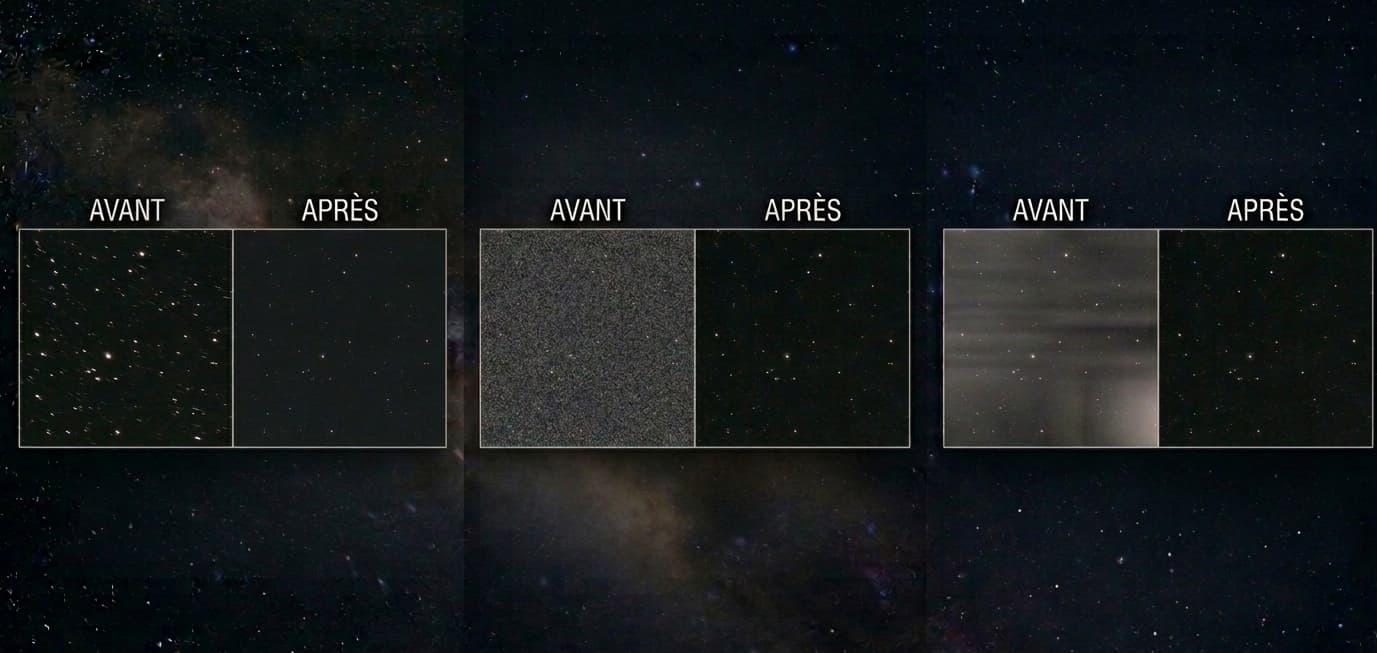
The rest belongs to post-processing: bright star cores clipped to pure white and visible chroma noise in the background, consistent with RGB channels shallower than the luminance. The 1.39 background to black point margin confirms a stretch that compressed the low lights.
Priority actions
- Go back to the linear master and extract the gradient with GraXpert or DBE before any stretch
- Raise the black point during the stretch to recover a background margin of at least 5
- Apply chroma noise reduction to the background, sparing the galaxies with a mask
- Check imaging train tilt with a dedicated aberration inspector run, the right half of the field being mushier
- Add short RGB exposures to rebuild the clipped bright star cores