Astrophotography diagnosis of RCW98: Sensor tilt and light pollution gradient
ProcessedHa, OIII, B, G, RHa 53×600s · OIII 24×600s · R 30×60s · G 30×60s · B 30×60s (total ~14.3 h)07 mai 2026
The Doc examined this image of RCW98 (processed, Ha, OIII, B, G, R, Ha 53×600s · OIII 24×600s · R 30×60s · G 30×60s · B 30×60s (total ~14.3 h)). Estimated overall technical quality: 7/10. 2 defects found: Sensor tilt (severity 2/5), Light pollution gradient (severity 2/5).
&w=1920&q=75)
Info
- Cible
- RCW98
- Date
- 07 mai 2026, 00:00
The 57% moon on the session night weighs on the sky background, consistent with the measured oriented gradient (71%, 73°). On RCW98, an emission target, the long Hα/OIII subs (600s) stay fairly moon-insensitive, which is the right choice. However the short RGB layers (R/G/B 60s) for stars caught the moonlight head-on, which explains part of the residual gradient on background and stars. If you shoot RGB under moon, schedule it on a darker night or lower its exposure while keeping Hα/OIII under moon.
Setup
- Type d'image
- Traitée
- Télescope
- Astro-Physics StarFire EDF "Gran Turismo" 130mm f/6.3
- Caméra
- ZWO ASI2600MM Pro
- Filtre
- Ha, OIII, B, G, R
- Monture
- Astro-Physics Mach1 GTO
- Exposition
- Ha 53×600s · OIII 24×600s · R 30×60s · G 30×60s · B 30×60s (total ~14.3 h)
- Phase de lune
- 57%
The StarFire EDF 130 f/6.3 (~820 mm) with ASI2600MM Pro gives roughly 0.95 arcsec/px, slightly oversampled but consistent with the measured FWHM (~1.5 px, ~1.4 arcsec), a sign of very clean seeing and tracking. The wide field suits the extent of RCW98 and its neighbors well. The residual measured tilt is the only caveat of the optical train: on this APS-C sensor a tilt-plate adjustment is enough to even out the corners. The Hα/OIII + RGB stars palette is appropriate for this emission region.
The diagnosis in detail
The PSF panel confirms very good optics at center and on three edges (elong ~1.09 on L/R/TL), but clear degradation along the BR/BL diagonal: BR reaches elong 1.75 (FWHM 1.64/0.94) and BL 1.40, while the center itself sits at 1.43 with a purely vertical asymmetry (0.143 vs 0.002 horizontal). This single-axis signature, combined with a 47.8° PA spread, points to mechanical sensor tilt rather than symmetric field curvature. It is mild and the image stays fully usable, but a tilt-plate adjustment will even out the corners.
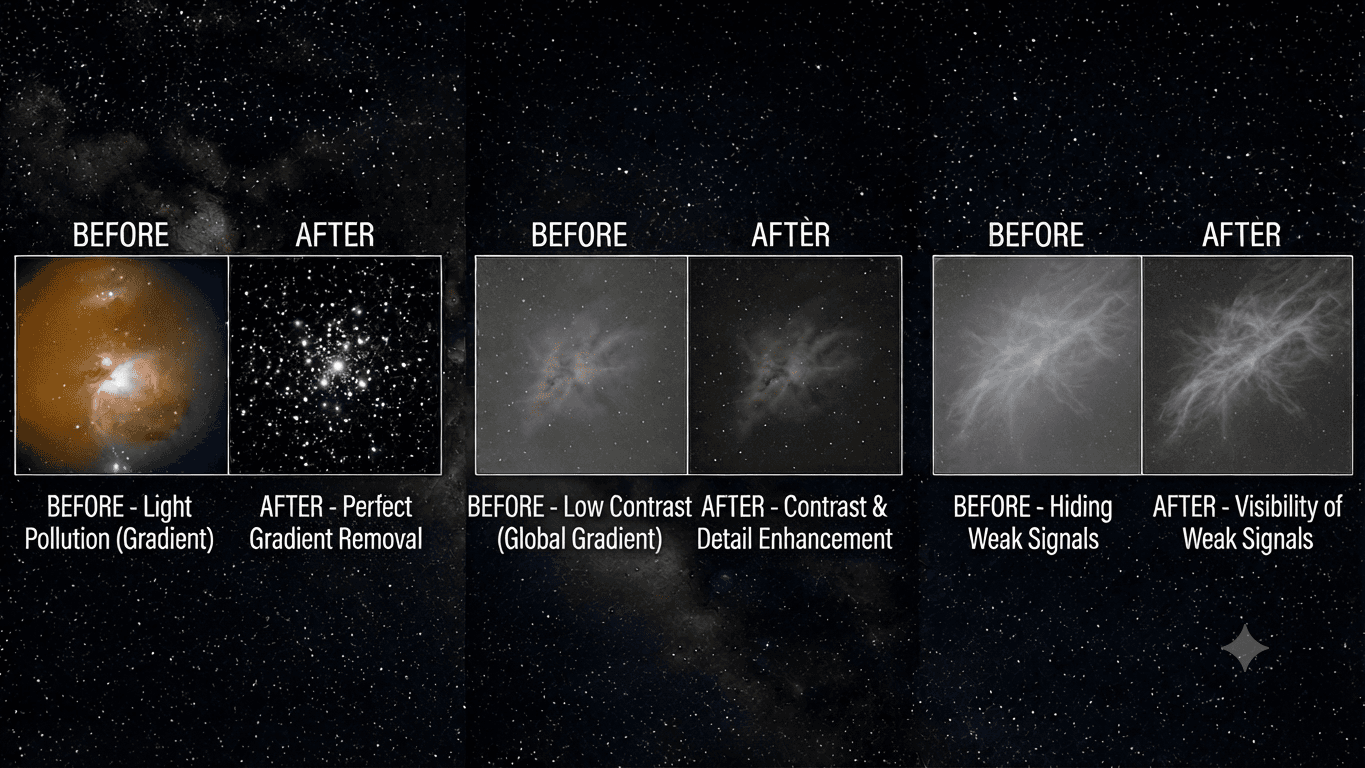
The second point is a measured background gradient at 71% oriented 73°, dominating the radial component by a factor of 2.4, so a genuine oriented gradient and not vignetting. The 57% moon largely explains this residual, especially on the short RGB exposures. More thorough gradient extraction (GraXpert/DBE with off-gas samples) will even out the background.
The rest is healthy: no clipping (0% saturated), no detectable drift or oscillation in tracking, and rich, well-resolved Hα nebulosity. The finish hinges mainly on these two instrumental corrections.
Priority actions
- Adjust the mechanical sensor tilt (tilt-plate / adapter screws) to even out the BR/BL corners
- Refine gradient extraction (GraXpert or DBE) by sampling the background off the nebulosity
- Schedule the short RGB layers on a moonless night to reduce the residual gradient