Astrophotography diagnosis of Rosette A: Sensor tilt and satellite trail
Raw120s11 janv. 2026
The Doc examined this image of Rosette A (raw, 120s). Estimated overall technical quality: 6/10. 2 defects found: Sensor tilt (severity 2/5), Satellite trail (severity 1/5).
&w=1920&q=75)
Info
- Cible
- Rosette A
- Date
- 11 janv. 2026, 22:18
- Lune
- Gibbeuse croissante 62.6% (sous l'horizon)
- Site
- Bortle 3 · rural peu pollué (VIIRS)
- Position
- 6h31m50s · +4°58'20"
Excellent conditions for the Rosette: Bortle 3 provides a very dark background, ideal for capturing the faint Halpha signal of this large emission nebula. The 62.6% gibbous Moon is below the horizon and 114.5 degrees from the target, so it has no influence. No light pollution gradient is expected or measured here. The only limiting factor is the single exposure length (120s) and the probable background underexposure (e_margin 2.43): in broadband RGB under this dark sky, you can comfortably extend exposures to 180-300s to better lift the background off the black point and improve SNR.
Setup
- Type d'image
- Brut
- Télescope
- TS-Optics 61 EDPH
- Caméra
- ATR585C
- Exposition
- 120s
- FOV
- 2.34°
The TS 61 EDPH (360mm refractor) and ATR585C pairing gives a 2.34 degree field that frames the Rosette (about 1.3 degrees) generously, with margin for the surrounding diffuse nebulosity: a coherent choice. The 585 sampling at this focal length lands around 1.6 arcsec/px, comfortable and well matched to current seeing (center FWHM ~4 px). Gain 100 and -10C are healthy. The offset at 0 deserves attention: with 22% dark clipping measured, check that the offset is not clipping the shadows, raising it slightly can help preserve the low tail of the histogram.
The diagnosis in detail
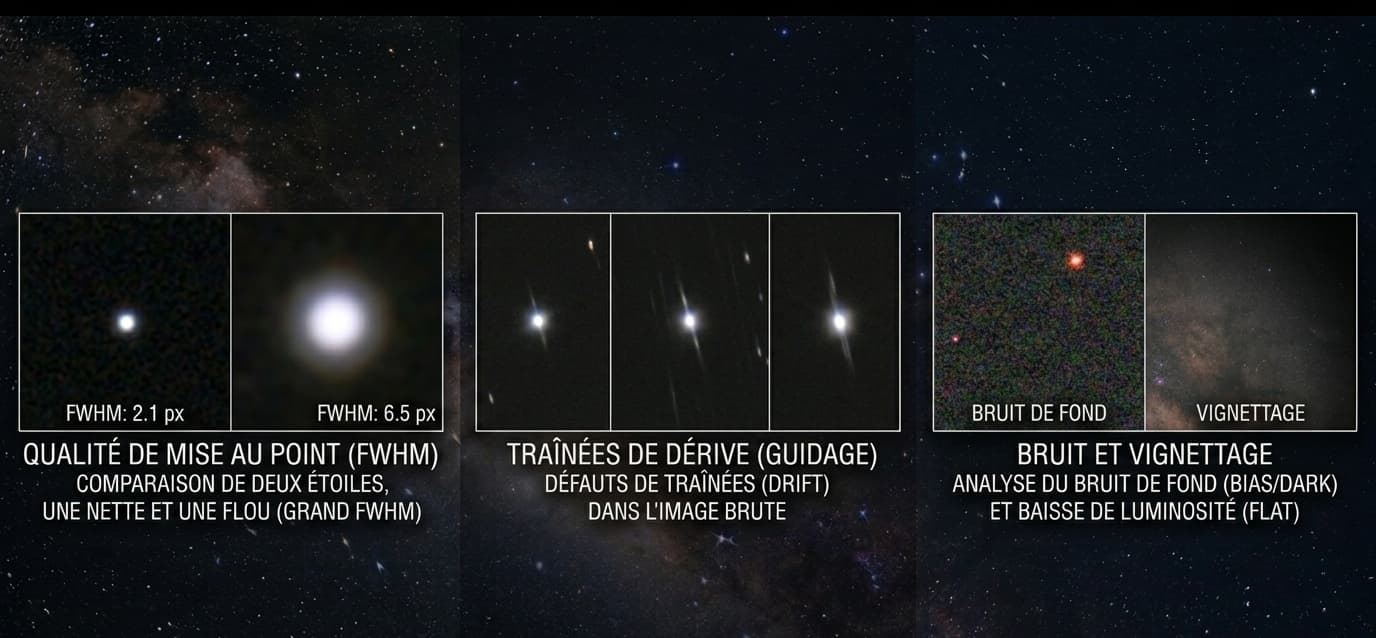
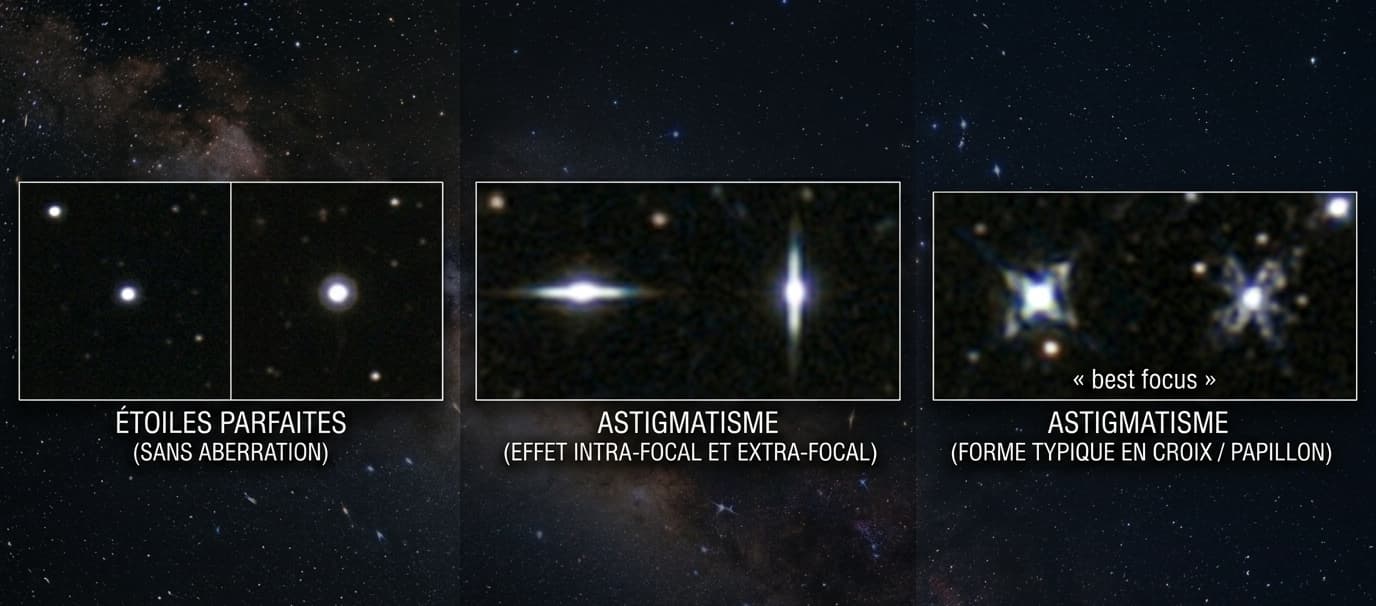
The aberration plate confirms tracking and optics are broadly healthy: the center is round (elong 1.12, barely above the field floor of 1.04) and PA dispersion is low. The measurable defect is a mild sensor tilt, signed by a FWHM asymmetry carried on a single axis: the right side (R 4.88, TR 4.72, BR 5.02 px) is consistently more bloated than the left side (~3.9 px), i.e. 0.26 horizontal asymmetry against 0.03 vertical. It is discreet and does not prevent use, but adjusting the flatness of the optical train would tighten the stars on the right.
The second point concerns color rendition: a strong green cast covers the whole field and masks the real color of the Rosette, which should turn red/pink in Halpha (the DSS reference confirms a warm hue). This is a processing issue (no SCNR and no color calibration), fully recoverable once the stack is assembled and balanced.
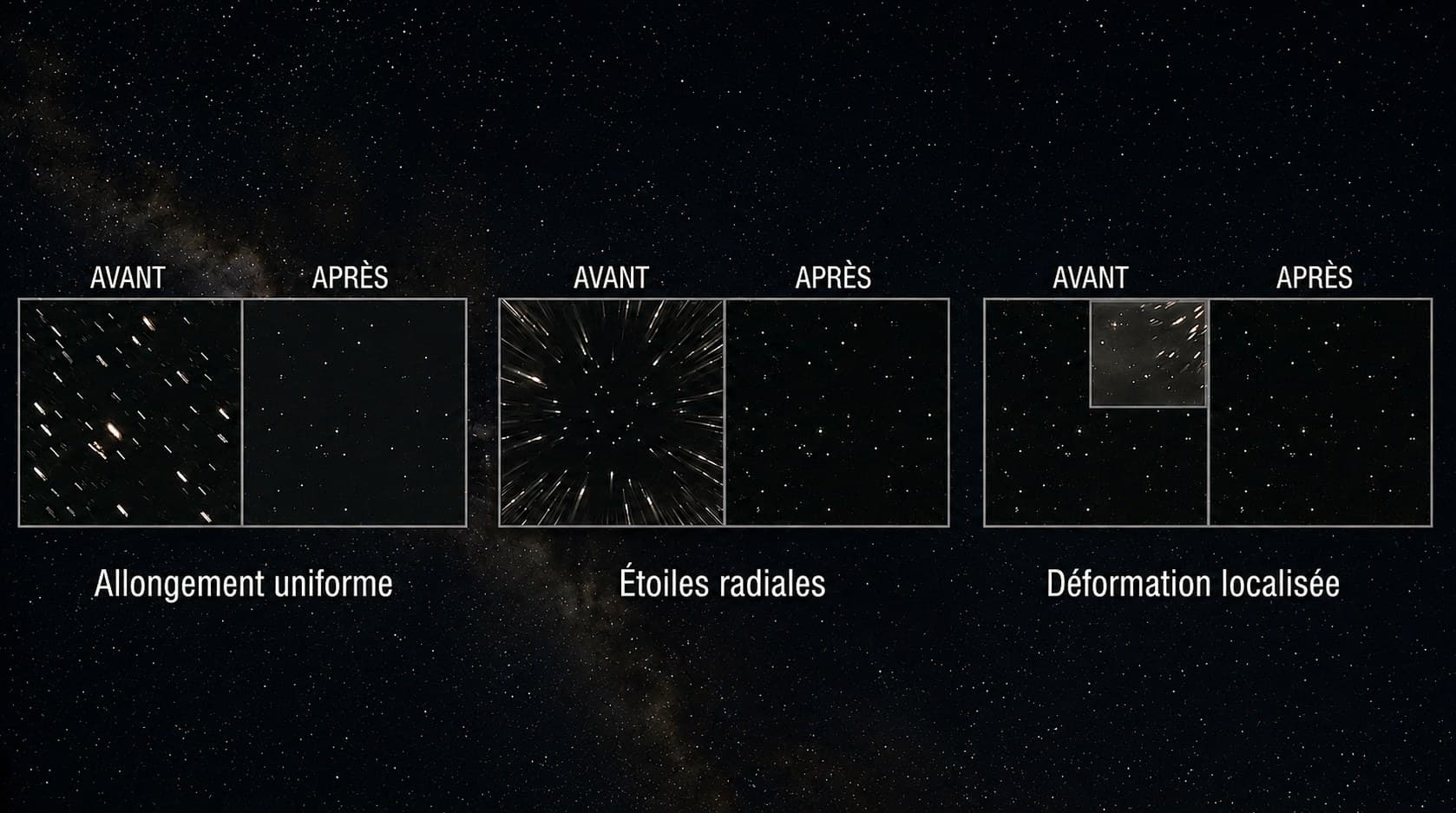
Finally, a satellite trail crosses the left edge: of no consequence, sigma rejection at stacking will make it disappear. The brownish/reddish nebulosity observed matches the real signal of the Rosette (confirmed by DSS), it is not a gradient.
Priority actions
- Fix the green cast in processing (SCNR + SPCC/PCC color calibration) once the stack is assembled
- Check the flatness and tightening of the optical train to reduce the right-side tilt, then re-check on an aberration plate
- Extend single exposures to 180-300s under this Bortle 3 sky to better lift the background and increase SNR
- Check the offset (22% dark clipping) and raise it slightly to preserve the low tail of the histogram