Astrophotography diagnosis of SH2-112: Light pollution gradient and backfocus error
ProcessedMULTIBAND136×300s25 mai 2026
The Doc examined this image of SH2-112 (processed, MULTIBAND, 136×300s). Estimated overall technical quality: 7/10. 2 defects found: Light pollution gradient (severity 3/5), Backfocus error (severity 2/5).
&w=1920&q=75)
Info
- Cible
- SH2-112
- Date
- 25 mai 2026, 00:00
- Position
- 4h02m60s · +51°19'12"
Moon at 90% on the shoot night: this is the main source of stray background and largely explains the measured gradient amplitude (42%). With a multiband filter on an emission target like SH2-112 this choice is defensible since narrow bands reject part of the lunar continuum, which let you bank 136x300s of usable data. On a broadband RGB target this full Moon would have been a dealbreaker. To improve further, favor moonless nights or frame the target far from the lunar disk to reduce the background ramp to model.
Setup
- Type d'image
- Traitée
- Télescope
- Sky-Watcher Quattro 200P
- Caméra
- Player One Ares-C Pro
- Filtre
- MULTIBAND
- Monture
- Sky-Watcher NEQ6-Pro
- Exposition
- 136×300s
- Phase de lune
- 90%
- Notes
- Logiciels : PHD2, Siril, Nighttime Imaging 'N' Astronomy (N.I.N.A. / NINA)
- FOV
- 1.80°
The Quattro 200P f/4 with the Ares-C Pro gives a 1.80 deg field, well suited to SH2-112, which sits in the central region without being lost: the framing centers it correctly with margin for the background. The Newton f/4 sampling stays comfortable for this target. The only setup point to fix is the coma corrector backfocus: the PSF panel shows FWHM rising symmetrically in the corners (ratio 1.21), typical of a slightly out of tolerance sensor distance on this demanding f/4. Fine adjustment in 0.5 mm steps will make corners match the center.
The diagnosis in detail
The image is well crafted: the SH2-112 core is well defined, stars are point-like at center (FWHM 5.86/5.51 px, elong 1.06, PA dispersion 31.8 deg indicating fairly round stars) and tracking on the PHD2-guided NEQ6 is not a problem. No trace of tilt (very low horizontal/vertical asymmetry, 0.02), drift or guiding oscillation.
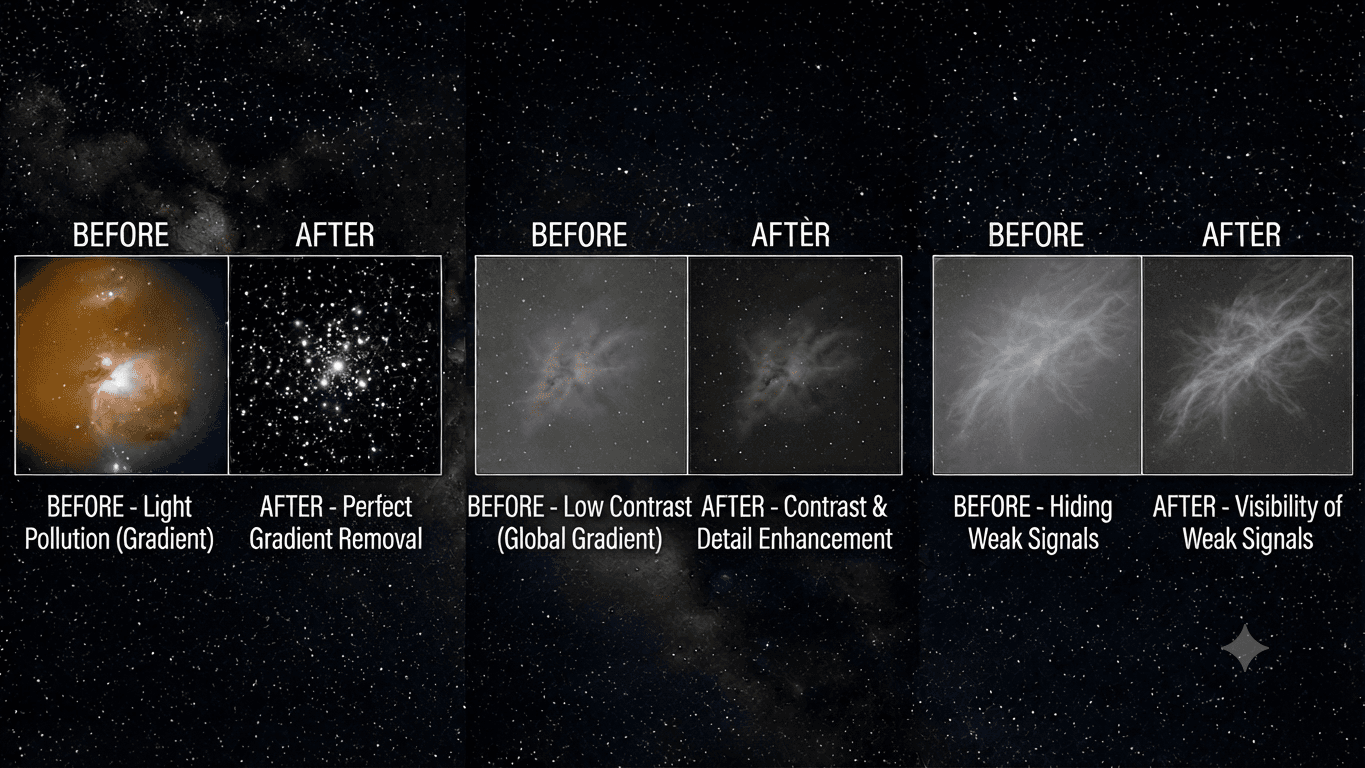
The dominant flaw is cosmetic and fixable: a linear background gradient at 42% oriented 292 deg, whose plane dominates the radial component by a factor of 4.9. The 90% Moon is the primary cause, amplified by incomplete gradient subtraction. This ramp matches no DSS structure, so it is not IFN: it must be cleanly removed on the linear image before any stretch.
The second point is optical and mild: FWHM rises symmetrically in all four corners (corner/center ratio 1.21, elong up to 1.18 in BL), without true coma, pointing to a slightly out of spec field curvature/backfocus on this f/4 Newton rather than a collimation fault. A fine corrector adjustment will be enough.
Priority actions
- Remove the gradient on the linear image (GraXpert or Siril) before stretching to flatten the background
- Adjust the coma corrector backfocus in 0.5 mm steps until corner and center FWHM match
- Favor moonless nights (or frame away from the lunar disk) to reduce stray background