Astrophotography diagnosis of SH2-188: Light pollution gradient, background chroma noise and 1 other
Processed
The Doc examined this image of SH2-188 (processed). Estimated overall technical quality: 8/10. 3 defects found: Light pollution gradient (severity 2/5), Background chroma noise (severity 2/5), Clipped stars (severity 2/5).
&w=1920&q=75)
Info
- Cible
- SH2-188
New moon at 0%: optimal conditions, no possible lunar contribution to the sky background, so the measured 4% gradient must be attributed to ground light pollution or a low altitude late in the session, not to the Moon. On an emission target like SH2-188, very faint and very extended, this absence of Moon is exactly what you want: it lets OIII, by far the most fragile channel here, build up properly. If you can prioritise moonless nights for this kind of object and keep moonlit nights for pure Ha, you will gain directly on background chroma noise.
Setup
- Type d'image
- Traitée
- Télescope
- RC10" TS optics
- Caméra
- ZWO 2600MM
- Phase de lune
- Nouvelle lune (0 %)
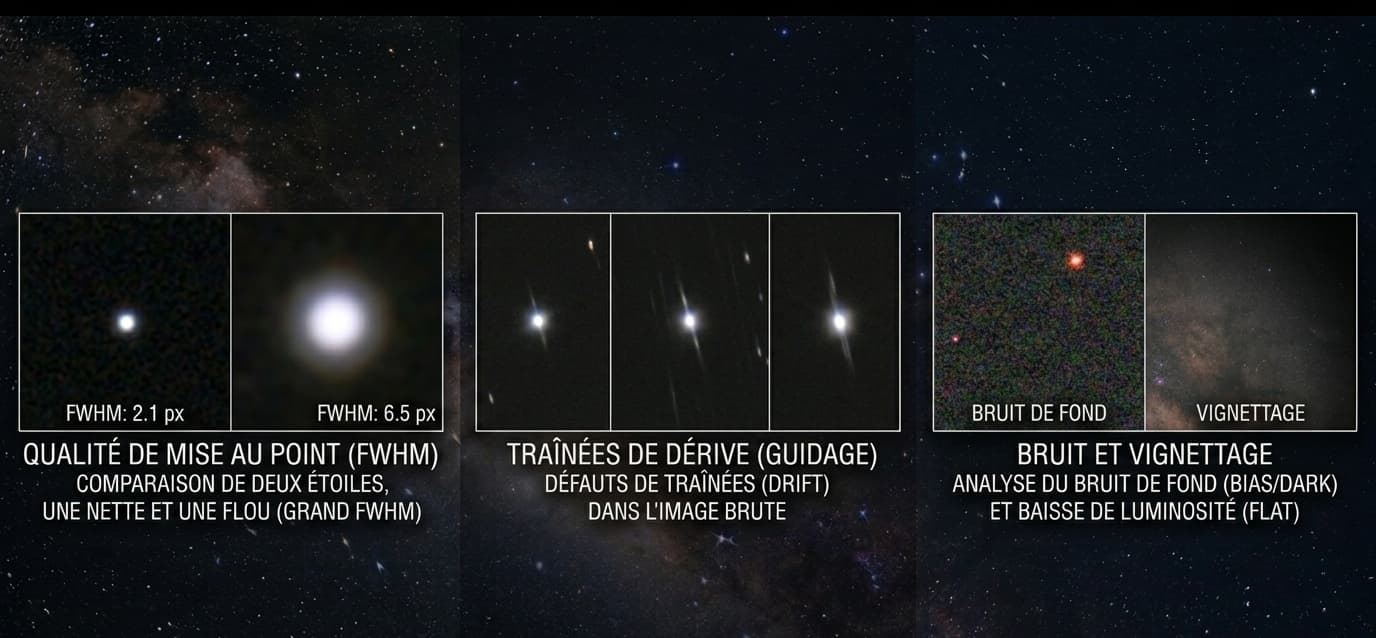
The RC10 TS plus ASI2600MM pairing suits SH2-188 well: the nebula fills about a third of the frame, nicely placed left of centre, with room for the faint outer halo extending downwards. The measured FWHM values, a fairly homogeneous 5 to 6.4 px, are typical of a long focal length RC on a small-pixel sensor: you are somewhat oversampled, which costs nothing in quality but dilutes the signal per pixel, hence the value of software binning 2 on OIII and SII during processing. On the histogram side, e_margin 2.08 with a Bowley skew of 0.69 indicates a background barely lifted off the black point, which is normal and expected in narrowband, with no dark clipping and no global saturation: the acquisition settings are healthy.
The diagnosis in detail
The optical and mechanical verdict is excellent. The PSF board shows round stars everywhere: elongation 1.02 at centre against a field floor of 1.01, values between 1.01 and 1.07 across the nine zones, and a PA dispersion of 44 degrees which precisely reflects round stars with no preferred direction. The corner/centre FWHM ratio of 1.14 and the horizontal asymmetry of 0.08 stay below field curvature thresholds: no tilt, no backfocus error, no coma, no tracking drift. On a long focal length RC10, that is a collimation and guiding result worth highlighting.
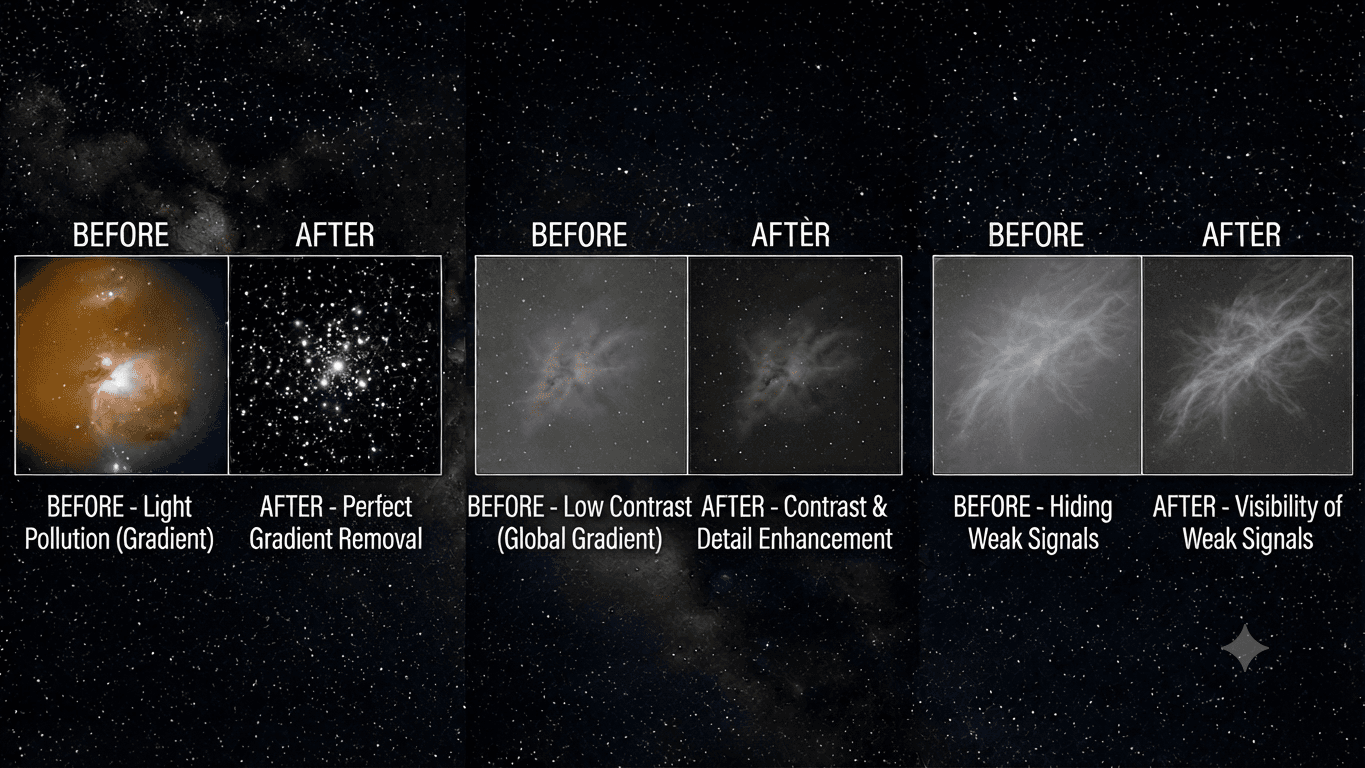
What remains is entirely about sky background and post-processing, and the two are linked. The 4% plane gradient oriented at 11 degrees, with R2 of 0.83 and a plane/radial dominance of 5.33, is the clear signature of an oriented gradient, not vignetting: your flat is doing its job, it is the gradient extraction that was not pushed far enough. This slightly tilted background in turn accentuates the perceived colour mottling in the empty areas, where OIII and SII SNR is weakest.
Finally, three or four bright stars show clipped white cores, with no major aesthetic consequence but limiting the refinement of the star rendering. None of these three points requires going back under the sky with the same gear: careful reprocessing plus extra integration on the weak channels will do.
Priority actions
- Redo gradient extraction on the linear image with GraXpert or DBE, sampling only background far from the nebulosity, to erase the residual 4% plane
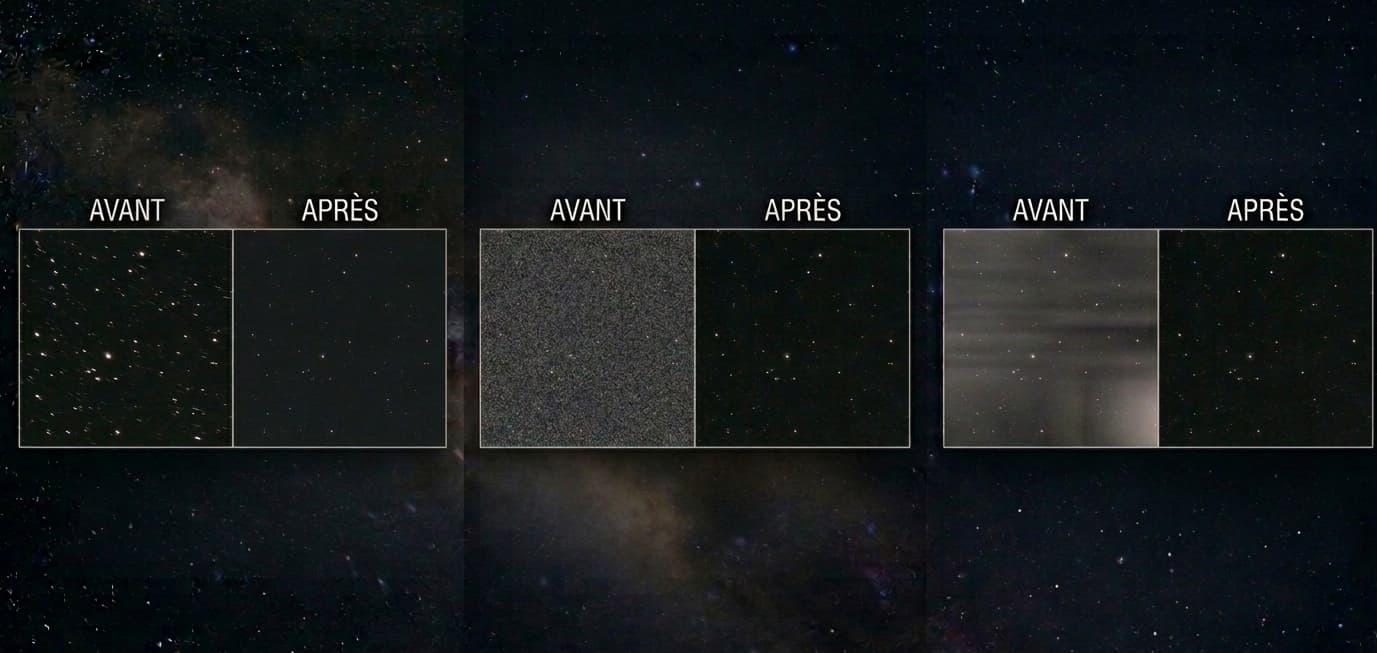
- Apply masked chroma denoising on the background and reduce saturation in the low lights to clear the colour mottling
- Extend integration on OIII and SII, the limiting channels, to improve background SNR at the source
- Add a set of short exposures to rebuild the cores of the three or four clipped bright stars
- Consider software binning 2 on the weak channels, since the field is oversampled with FWHM of 5 to 6 px
Similar diagnoses

M 33 - Triangulum Galaxy
Sensor tilt

Pléiades
Light pollution gradient

Quintet de Stephen
Light pollution gradient
Related articles
 Sky background gradients in astrophotography: light pollution, Moon, and fixes
 How to Analyze an Astrophoto Light Frame Before Stacking
 Astrophotography Problems: Solutions for Successful Images