Astrophotography diagnosis of SH2-221 + SH2-217: Light pollution gradient, backfocus error and 1 other
ProcessedMULTIBAND94×300s18 janv. 2026
The Doc examined this image of SH2-221 + SH2-217 (processed, MULTIBAND, 94×300s). Estimated overall technical quality: 6/10. 3 defects found: Light pollution gradient (severity 3/5), Backfocus error (severity 2/5), Astigmatism (severity 2/5).
&w=1920&q=75)
Info
- Cible
- SH2-221 + SH2-217
- Date
- 18 janv. 2026, 00:00
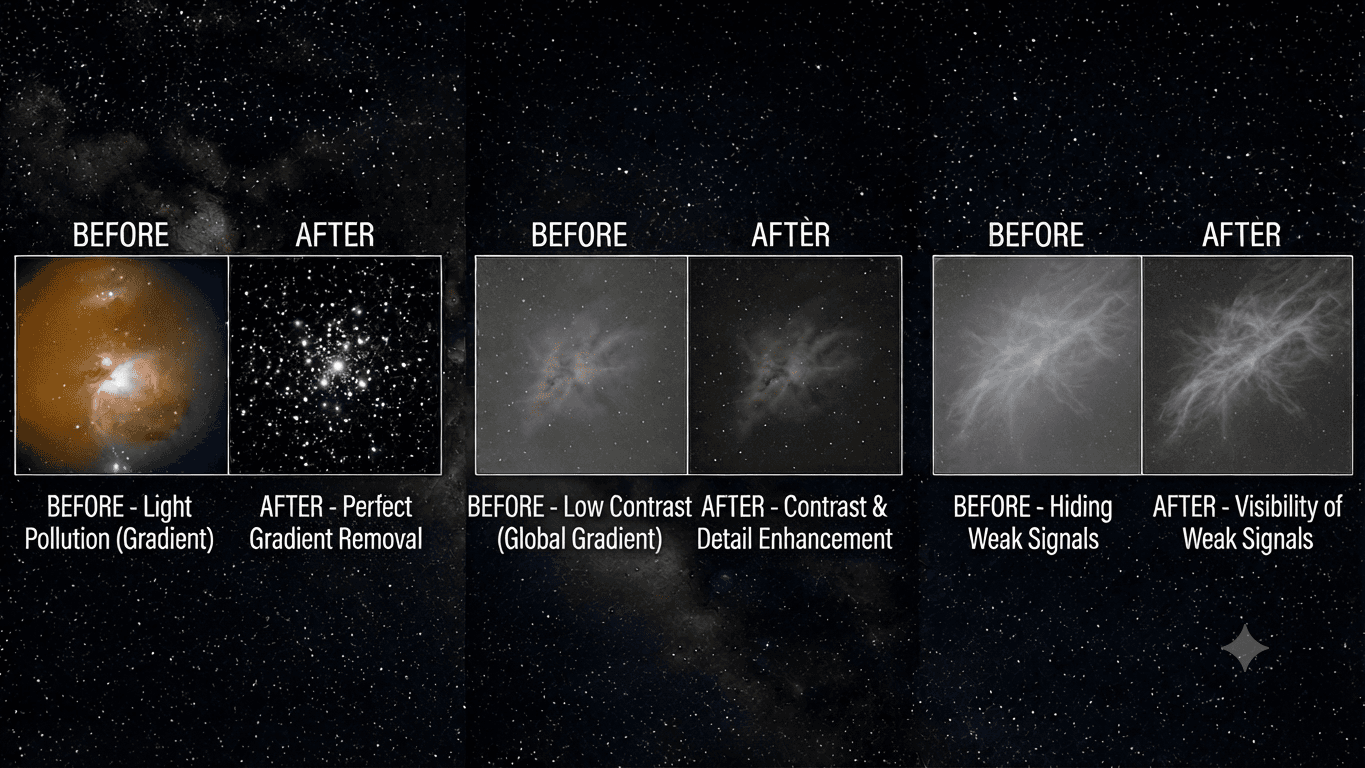
Moon at 0%, so no lunar pollution possible: the gradient measured toward the top-left corner is necessarily urban or atmospheric in origin (scattering near the horizon). For a faint, extended emission target like SH2-221/217 this is a nuisance because the Ha signal is drowned in the background. With 94x300s, nearly 8h of integration, the nebula SNR is decent, but the residual gradient calls for careful extraction. If the session repeats from a polluted site, favor nights of better transparency and aim higher in altitude to limit atmospheric scattering.
Setup
- Type d'image
- Traitée
- Télescope
- William Optics GT71
- Caméra
- ZWO ASI2600MC Pro
- Filtre
- MULTIBAND
- Monture
- iOptron CEM26
- Exposition
- 94×300s
- Phase de lune
- 0%
The GT71 (focal length ~336mm with reducer) on an ASI2600MC Pro gives a wide field perfectly suited to these two extended emission nebulae, well contained in the frame. Sampling is generous (around 2.3 arcsec/px), slightly undersampled but which also explains the low measured FWHM: tight, compact stars. The multiband filter is the right choice on an emission target from a polluted sky, isolating Ha. The slight field curvature seen at the edges is typical of a compact APO on a large sensor: a fine backfocus adjustment will flatten it further.
The diagnosis in detail
The PSF panel confirms healthy tracking and optics at center: elong 1.07 at center for a field floor of 1.02, FWHM of 1.46px, high PA dispersion (58 degrees) indicating essentially round stars, no drift or guiding oscillation. This is a quality acquisition on the mount side (well-tuned iOptron CEM26). The curvature/backfocus pre-verdict holds but in mild form: FWHM rises fairly symmetrically toward edges (B 1.98, R 2.72, BR 1.64) with oval stars and no clear radial coma, corner/center ratio only 1.135. The R zone is biased by a bright star, so its 2.72px should be down-weighted. This is an optimization point, not a blocking defect.
The real issue is the sky background: a very marked plane gradient (253%, R2=0.89) oriented at 228 degrees largely dominates any radial symmetry. Moon at 0%, so urban/atmospheric origin. It darkens the rendering and pulls the background toward mauve in the top-left corner, which also shifts color balance. Gradient extraction on the linear data followed by color calibration would restore a neutral background and bring out the filamentary Ha signal.
Priorities: handle the gradient, then recalibrate color, and finally adjust backfocus for future sessions.
Priority actions
- Extract the background gradient (GraXpert/DBE) on the linear master before any stretch
- Re-run color calibration (SPCC/PCC) to neutralize the mauve background cast
- Finely adjust backfocus in 0.5mm steps to flatten edge stars in future sessions