Astrophotography diagnosis of Vega: Tracking drift and clipped stars
ProcessedUV ir cut2x 5s
The Doc examined this image of Vega (processed, UV ir cut, 2x 5s). Estimated overall technical quality: 4/10. 2 defects found: Tracking drift (severity 3/5), Clipped stars (severity 2/5).
&w=1920&q=75)
Info
- Cible
- Vega
Conditions are not limiting here: last crescent at 6%, the Moon is negligible and induces no gradient. The reported seeing of 3.8 is average but irrelevant on a 5 s exposure dominated by tracking, not turbulence. On a simple star test like this, the limiting factor is neither sky nor Moon but the mount mechanics. Nothing to adjust on the conditions side: the sky is usable, tracking stability is what bounds the result.
Setup
- Type d'image
- Traitée
- Télescope
- Skywatcher Dobson Flextube 305/1500
- Caméra
- Pegasus astro smarteye
- Filtre
- UV ir cut
- Monture
- Dobson
- Exposition
- 2x 5s
- Phase de lune
- Dernier croissant (6 %)
- Seeing
- 3.8
The Flextube 305/1500 Dobson is an excellent visual instrument but its alt-azimuth mount is the weak link for imaging: without equatorial drive, drift and field rotation trail the stars within a few seconds, as the field here confirms. At 1500 mm the sampling is tight, which visually amplifies any tracking flaw. For deep sky, an equatorial platform (EQ platform) or an equatorial mount would change everything. As is, the setup suits star test/focus, not long exposures.
The diagnosis in detail
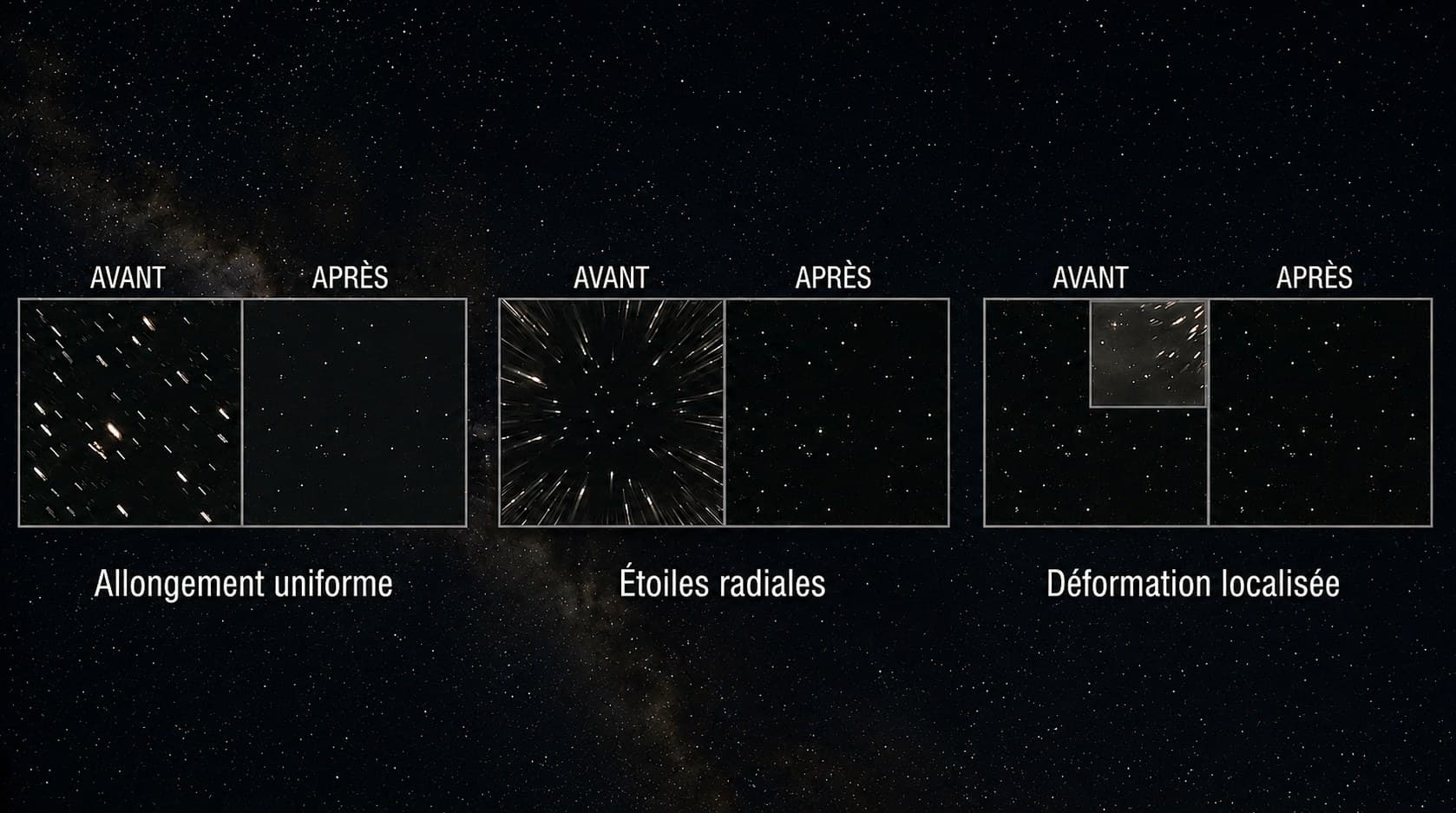
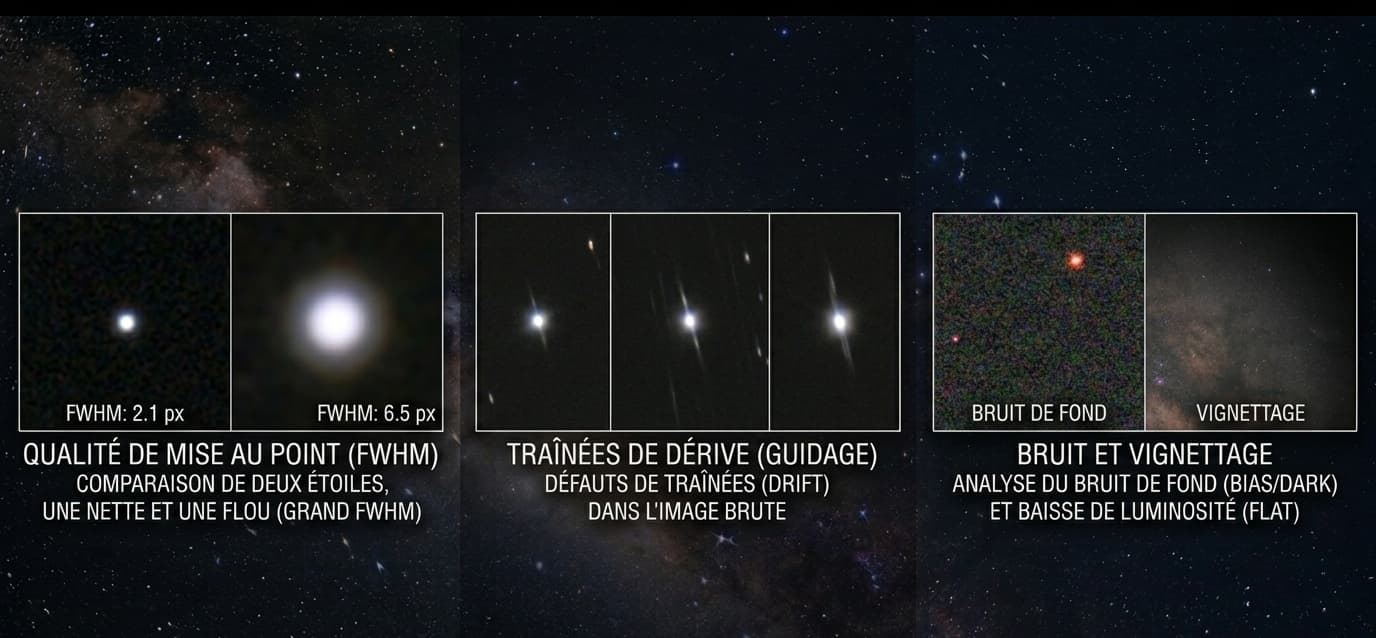
The image is a test on Vega, and as such the sharp central core indicates correct focus: the long cross spikes are the nominal secondary-spider diffraction of a Newton, not to be confused with an anomaly. The real lesson is in the faint field stars, all elongated into small parallel streaks of comparable length. This uniform, directional signature points to tracking drift during the exposure, consistent with an alt-azimuth Dobson mount that compensates for neither drift nor field rotation. The short exposures (5 s) limit the amplitude but do not cancel it. Vega's core is saturated into a white plateau, normal for a mag 0 source and only a problem if you want to preserve the stellar profile. The background stays clean, with no gradient or notable noise given the subject. If deep-sky imaging becomes the goal, the priority is to secure tracking before anything else: shorter exposures help, but only an equatorial correction will truly remove the trailing.
Priority actions
- Fix tracking: add an equatorial platform or move to an equatorial mount to remove drift and field rotation
- Shorten exposures (1 to 2 s) and stack more subs to limit residual trailing
- Cull subs and reject the most trailed before integration
- To preserve Vega's core, plan short HDR exposures or lower the gain